 In this post, we look at the history of British Navy rum from 1824 to 1823.
1824-1850
Organisational changes
The importance of rum within the fleet is also evident from the fact that, in 1831, rum became a permanent fixture in the daily ration; this was because the general issue of beer to the fleet was discontinued that year. [2-71]
In 1832, far-reaching reforms gave the Admiralty more direct control over civilian departments, including those responsible for provisions. From this point onwards, the victualling commissioners were no longer autonomous but were placed under the authority of a Sea Lord with the new title of ‘Controller of Victualling’. As a result, quality control over all the seamen’s provisions was concentrated in a single authority. It was his responsibility – and no one else’s – to ensure that the taste, colour and other characteristics of the rum met the seamen’s expectations. [2-43]
Queen Victoria was Queen of the United Kingdom from 1837 to 1901. [5] The reign of rum began at roughly the same time as her accession to the throne. By 1837, the system for receiving, storing and distributing rum was far better organised than before. Rum was de facto recognised as part of the daily ration. This meant that ship’s crews were entitled to it and rarely resorted to substitute products. [2-73] Rum was now taken on board by all ships upon their departure. As a result, brandy was supplanted, and arrack was scarcely mentioned anymore. [2-74]
1850-1918
Ban on grain distillation
William Beckford was a Member of Parliament and Lord Mayor of London, and came from a powerful Jamaican family of sugar cane planters. In the 1850s, grain harvests were poor, and, together with the sugar lobby, he pushed through a law banning the distillation of grain. This opened up a new market for rum. [3-16] [3-17]
Improving the quality of rum
In 1850, a committee set up by the Admiralty recommended the complete abolition of the daily rum ration. This proposal was not adopted; instead, the ration was halved and distributed only once a day. [4] This drastic reduction in quantity highlighted the need to prioritise quality over quantity. It was therefore the task of the Quartermaster’s Department to ensure this. Taste was important, but the bouquet also became increasingly significant. The blending of rum thus became ever more important, and eventually an established blend emerged. It consisted of Demerara and Trinidad rum, together with a small proportion of other types of rum. The exact recipe was always a closely guarded secret. There are very few references to it. [2-85]
Composition of the Navy Blend
In Deptford, the casks used for the blend were never completely emptied, so that a certain continuity of flavour could be maintained, much like in a solera system. [1] However, the blend produced in this way in Deptford has changed over time. [3-16]
Originally, the rum probably came mainly from Jamaica or Barbados. In the 19th century, rum from Demerara predominated, blended with lighter rums from Trinidad and Barbados. [3-16] Initially, most of the rum in Great Britain came from Jamaica, whilst Barbados traded mainly with the American colonies. From the 1740s onwards, other sugar-producing colonies were added. By 1744, for example, there were already seven plantations in British Guiana (also known as Demerara). By 1769, there were already 56. [3-17] By the end of the 18th century, the Jamaican sugar plantations were generating 15 million pounds a year, which was five times more than any other colony. [3-17] In the first chapter, I used statistics to show how the quantities and origins of imported rum changed over time.
Jamaikan rum
It is worth noting at this point that Jamaican rum was initially not quite what we understand it to be today. In the 19th century, the sugar industry experienced a slump in sales, and planters had to decide whether to continue with sugar or switch to rum. As a result, other raw materials became available for rum production. In addition, new distillation methods became available. The new, lighter varieties of rum were regarded as being of higher quality and commanded higher prices. According to Charles Tovey, distillation in Demerara had “a high state of perfection… to be as much prized in the American market as Jamaica is preferred in the English market“. Jamaican rum, with its pot-still distilleries, came under pressure. For Jamaica, this meant that it had to find a way to distinguish itself from the other types of rum. [3-22] [3-23] [3-24] And Jamaica’s strategy proved successful. In 1904, it was stated: “In the West Indies a large proportion of the produce of the cane is exported in the form of rum and molasses: in Jamaica the cane has held its ground largely in consequence of the excellence and reputation of the rum produced on certain sugar estates.” [7-151]
Accordingly, in 1914 we read: “The manufacture of Jamaica rum receives a large share of attention. The average annual export is 1,300,000 gallons. Nearly all the rum is exported to the United Kingdom.” [6-390]
Guyana-Rum
The importance of rum from British Guiana, also known as Demerara, grew thanks to the large number of labourers from China and India who were available there. In 1849, some 300 distilleries, each with its own distillery, ensured that almost half of the rum imported into Britain was Demerara rum. [3-26] This was a remarkable increase, given that it was not until 1815 that Josias and George Booker settled there and, in 1835, began shipping sugar to Liverpool, thereby transforming the landscape of British rum imports. By 1866, they were described as »the principal shopkeepers of the colony«. Liverpool thus quickly became the most important rum port, having expanded its docks in the 18th century and kept berthing fees lower than those in London. British Guiana became increasingly important due to the volumes it supplied and the diverse range of brands available for the blends; as a result, by the end of the 19th century, the Navy Blend no longer contained any Jamaican rum at all, but was predominantly made up of Demerara rum. [3-26] [3-27]
Guyana was a major exporter of rum: “The sugar industry is the most important in British Guiana. It contributes 75 per cent, of the total value of the exports and about 33 per cent, of the wage-earning portion of the population are indirectly associated with it. … The exports in 1911-12 were … 3,022,831 gallons of rum … .” [6-390] “British Guiana is the largest exporter of rum in the West Indies. The bulk is shipped to the United Kingdom.« [6-391]
The blend
The importance of blending is confirmed by an official investigation into rum losses in Deptford carried out in 1886. The customs inspector commented: “The most notable part of the system pursued consists in the blending and transfer of the rum from vat to vat, and I am of the opinion that it is admirably designed to improve the quality of the liquor.” [2-86]
The colour of the rum was also important, albeit less so than its aroma. Dark rum was preferred, and so, before being delivered to the ships, the rum was officially coloured dark using “caramel or dark sugar” – presumably meaning caramel colouring. [2-86]
In 1866, it was stipulated that the rum issued must have an alcohol content of ‘4.5 under proof’. The rum issued came from the West Indies. Most of it was Demerara rum from the colony then known as British Guinea. Rum from Trinidad was added to make it lighter, along with a small proportion from Barbados, Cuba, Martinique – so we can see that it was not exclusively rum from British colonies – and other countries. It was purchased on the basis of samples taken at the docks and then, following successful testing, transported to Deptford. There it was stored in casks with a capacity of between 4,000 and 32,000 gallons. Samples of the various blends were retained. Whenever there were complaints or significant changes to the range, these samples were consulted and tasting committees were convened. By that time, the blending process had already reached such a high level of sophistication and was approached so scientifically that the cost of the blend could be reduced by using cheaper rums in the mixtures without compromising on flavour, as the blend was always intended to taste the same. [2-94]
1918-1970
Disasters in Deptford
During the 20th century, the Deptford warehouse was struck by disaster on two occasions. In 1927, the River Thames flooded the rum cellars and destroyed the entire stock. In 1941, the Deptford warehouse fell victim to the Blitz, and more than a quarter of a million gallons of rum were destroyed. [2-106] Nevertheless, it was possible to maintain the supply of rum.
Increased demand in times of war
During both world wars, many seamen were on active duty and there were major problems in supplying ships and overseas bases with rum. Furthermore, demand tripled compared with peacetime. But the challenges were overcome. [2-106]
The Second World War brought with it particular problems, as it became increasingly difficult, year on year, to source rum from the West Indies. One million gallons of rum were required annually. In 1943, the Admiralty finally considered abolishing the rum ration. To maintain the morale of the seamen, they wanted to avoid this, and another solution was found. The Treasury had authorised funds to purchase expensive and immature rum from Cuba and Martinique. This was not looked upon favourably, as the rum thus came from countries that did not belong to the Commonwealth. [2-106] [2-107]
In the waters of South-East Asia and the Far East, ships were supplied with rum from Natal. However, this rum was not blended and was extremely unpopular. It came from the ‘National Chemical Syndicate’ distillery, which supplied the Admiralty until 1961. It was usually aged in casks in Great Britain for five years. [2-107] As we can see, Natal rum was apparently also blended into the mix during those years.
The next instalment in this series will look at the blend used for British Navy rum.
Sources
- Tristan Stephenson: The curious bartender’s guide to rum. E-ISBN 978-1-78879-303-2. 2020.
- https://archive.org/details/nelsonsbloodstor0000pack/page/128/mode/2up A. J. Pack: Nelson’s blood – the story of naval rum. ISBN 0-87021-944-8. Reprint October 1983.
- https://archive.org/details/rummanual0000broo/page/14/mode/2up Dave Broom: Rum. The Manual. ISBN 978-1-84533-962-3. 2016.
- https://de.wikipedia.org/wiki/Black_Tot_Day Black Tot Day.
- https://de.wikipedia.org/wiki/Victoria_(Vereinigtes_K%C3%B6nigreich) Victoria (Vereinigtes Königreich).
- https://archive.org/details/cu31924087992719/page/384/mode/2up?q=rum A. J. Herbertson & O. J. R. Howarth (Hrsg.): The Oxford survey of the British Empire. America. Oxford, 1914.
- https://archive.org/details/cu31924021048750/page/n183/mode/2up?q=rum Edward John Payne: Colonies and colonial federations. London, 1904.
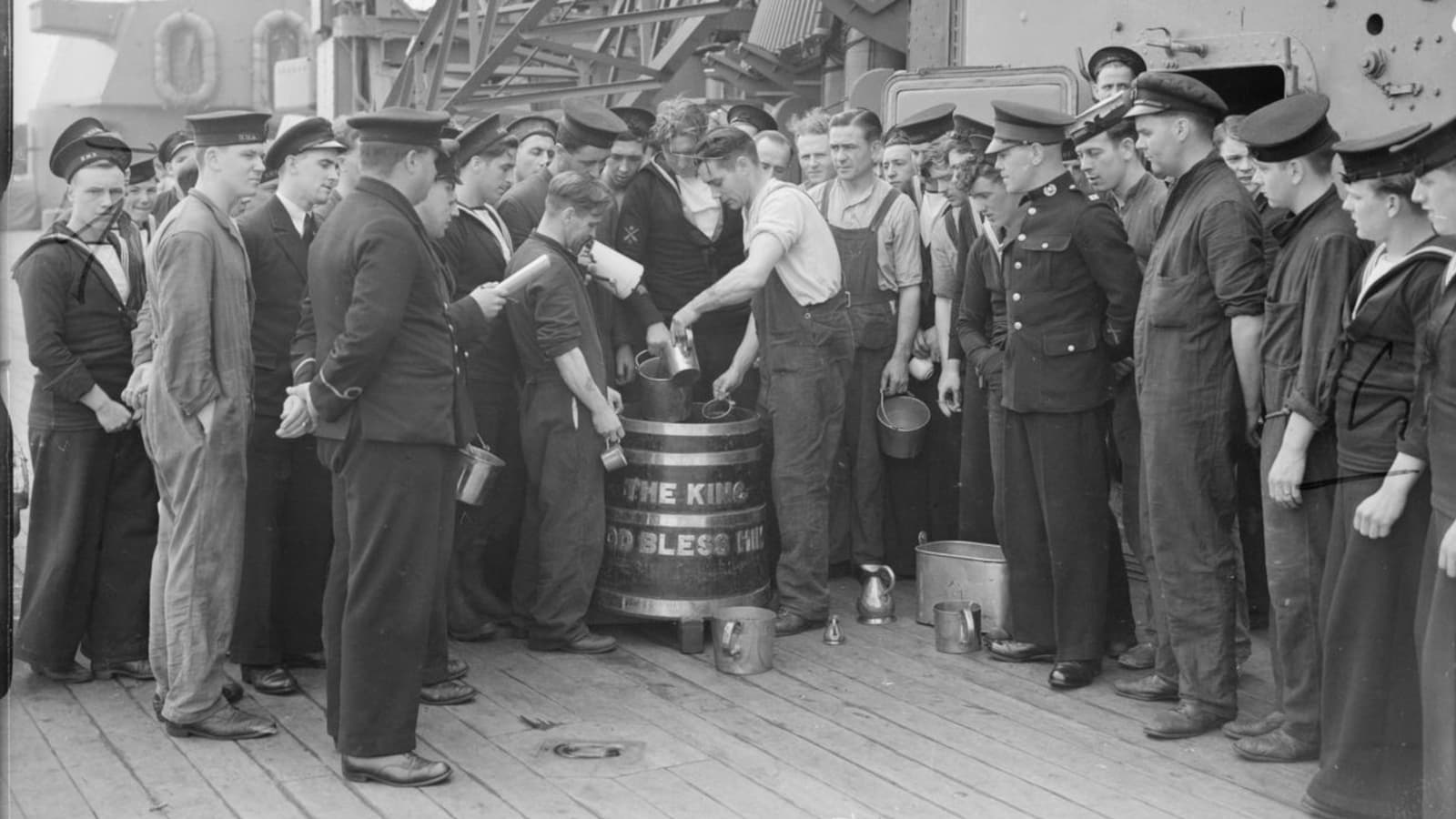
- Cover picture: https://commons.wikimedia.org/wiki/File:The_Royal_Navy_during_the_Second_World_War_A103.jpg The Royal Navy during the Second World War.
explicit capitulum
*



1824-1850
Organisational changes
The importance of rum within the fleet is also evident from the fact that, in 1831, rum became a permanent fixture in the daily ration; this was because the general issue of beer to the fleet was discontinued that year. [2-71]
In 1832, far-reaching reforms gave the Admiralty more direct control over civilian departments, including those responsible for provisions. From this point onwards, the victualling commissioners were no longer autonomous but were placed under the authority of a Sea Lord with the new title of ‘Controller of Victualling’. As a result, quality control over all the seamen’s provisions was concentrated in a single authority. It was his responsibility – and no one else’s – to ensure that the taste, colour and other characteristics of the rum met the seamen’s expectations. [2-43]
Queen Victoria was Queen of the United Kingdom from 1837 to 1901. [5] The reign of rum began at roughly the same time as her accession to the throne. By 1837, the system for receiving, storing and distributing rum was far better organised than before. Rum was de facto recognised as part of the daily ration. This meant that ship’s crews were entitled to it and rarely resorted to substitute products. [2-73] Rum was now taken on board by all ships upon their departure. As a result, brandy was supplanted, and arrack was scarcely mentioned anymore. [2-74]
1850-1918
Ban on grain distillation
William Beckford was a Member of Parliament and Lord Mayor of London, and came from a powerful Jamaican family of sugar cane planters. In the 1850s, grain harvests were poor, and, together with the sugar lobby, he pushed through a law banning the distillation of grain. This opened up a new market for rum. [3-16] [3-17]
Improving the quality of rum
In 1850, a committee set up by the Admiralty recommended the complete abolition of the daily rum ration. This proposal was not adopted; instead, the ration was halved and distributed only once a day. [4] This drastic reduction in quantity highlighted the need to prioritise quality over quantity. It was therefore the task of the Quartermaster’s Department to ensure this. Taste was important, but the bouquet also became increasingly significant. The blending of rum thus became ever more important, and eventually an established blend emerged. It consisted of Demerara and Trinidad rum, together with a small proportion of other types of rum. The exact recipe was always a closely guarded secret. There are very few references to it. [2-85]
Composition of the Navy Blend
In Deptford, the casks used for the blend were never completely emptied, so that a certain continuity of flavour could be maintained, much like in a solera system. [1] However, the blend produced in this way in Deptford has changed over time. [3-16]
Originally, the rum probably came mainly from Jamaica or Barbados. In the 19th century, rum from Demerara predominated, blended with lighter rums from Trinidad and Barbados. [3-16] Initially, most of the rum in Great Britain came from Jamaica, whilst Barbados traded mainly with the American colonies. From the 1740s onwards, other sugar-producing colonies were added. By 1744, for example, there were already seven plantations in British Guiana (also known as Demerara). By 1769, there were already 56. [3-17] By the end of the 18th century, the Jamaican sugar plantations were generating 15 million pounds a year, which was five times more than any other colony. [3-17] In the first chapter, I used statistics to show how the quantities and origins of imported rum changed over time.
Jamaikan rum
It is worth noting at this point that Jamaican rum was initially not quite what we understand it to be today. In the 19th century, the sugar industry experienced a slump in sales, and planters had to decide whether to continue with sugar or switch to rum. As a result, other raw materials became available for rum production. In addition, new distillation methods became available. The new, lighter varieties of rum were regarded as being of higher quality and commanded higher prices. According to Charles Tovey, distillation in Demerara had “a high state of perfection… to be as much prized in the American market as Jamaica is preferred in the English market“. Jamaican rum, with its pot-still distilleries, came under pressure. For Jamaica, this meant that it had to find a way to distinguish itself from the other types of rum. [3-22] [3-23] [3-24] And Jamaica’s strategy proved successful. In 1904, it was stated: “In the West Indies a large proportion of the produce of the cane is exported in the form of rum and molasses: in Jamaica the cane has held its ground largely in consequence of the excellence and reputation of the rum produced on certain sugar estates.” [7-151]
Accordingly, in 1914 we read: “The manufacture of Jamaica rum receives a large share of attention. The average annual export is 1,300,000 gallons. Nearly all the rum is exported to the United Kingdom.” [6-390]
Guyana-Rum
The importance of rum from British Guiana, also known as Demerara, grew thanks to the large number of labourers from China and India who were available there. In 1849, some 300 distilleries, each with its own distillery, ensured that almost half of the rum imported into Britain was Demerara rum. [3-26] This was a remarkable increase, given that it was not until 1815 that Josias and George Booker settled there and, in 1835, began shipping sugar to Liverpool, thereby transforming the landscape of British rum imports. By 1866, they were described as »the principal shopkeepers of the colony«. Liverpool thus quickly became the most important rum port, having expanded its docks in the 18th century and kept berthing fees lower than those in London. British Guiana became increasingly important due to the volumes it supplied and the diverse range of brands available for the blends; as a result, by the end of the 19th century, the Navy Blend no longer contained any Jamaican rum at all, but was predominantly made up of Demerara rum. [3-26] [3-27]
Guyana was a major exporter of rum: “The sugar industry is the most important in British Guiana. It contributes 75 per cent, of the total value of the exports and about 33 per cent, of the wage-earning portion of the population are indirectly associated with it. … The exports in 1911-12 were … 3,022,831 gallons of rum … .” [6-390] “British Guiana is the largest exporter of rum in the West Indies. The bulk is shipped to the United Kingdom.« [6-391]
The blend
The importance of blending is confirmed by an official investigation into rum losses in Deptford carried out in 1886. The customs inspector commented: “The most notable part of the system pursued consists in the blending and transfer of the rum from vat to vat, and I am of the opinion that it is admirably designed to improve the quality of the liquor.” [2-86]
The colour of the rum was also important, albeit less so than its aroma. Dark rum was preferred, and so, before being delivered to the ships, the rum was officially coloured dark using “caramel or dark sugar” – presumably meaning caramel colouring. [2-86]
In 1866, it was stipulated that the rum issued must have an alcohol content of ‘4.5 under proof’. The rum issued came from the West Indies. Most of it was Demerara rum from the colony then known as British Guinea. Rum from Trinidad was added to make it lighter, along with a small proportion from Barbados, Cuba, Martinique – so we can see that it was not exclusively rum from British colonies – and other countries. It was purchased on the basis of samples taken at the docks and then, following successful testing, transported to Deptford. There it was stored in casks with a capacity of between 4,000 and 32,000 gallons. Samples of the various blends were retained. Whenever there were complaints or significant changes to the range, these samples were consulted and tasting committees were convened. By that time, the blending process had already reached such a high level of sophistication and was approached so scientifically that the cost of the blend could be reduced by using cheaper rums in the mixtures without compromising on flavour, as the blend was always intended to taste the same. [2-94]
1918-1970
Disasters in Deptford
During the 20th century, the Deptford warehouse was struck by disaster on two occasions. In 1927, the River Thames flooded the rum cellars and destroyed the entire stock. In 1941, the Deptford warehouse fell victim to the Blitz, and more than a quarter of a million gallons of rum were destroyed. [2-106] Nevertheless, it was possible to maintain the supply of rum.
Increased demand in times of war
During both world wars, many seamen were on active duty and there were major problems in supplying ships and overseas bases with rum. Furthermore, demand tripled compared with peacetime. But the challenges were overcome. [2-106]
The Second World War brought with it particular problems, as it became increasingly difficult, year on year, to source rum from the West Indies. One million gallons of rum were required annually. In 1943, the Admiralty finally considered abolishing the rum ration. To maintain the morale of the seamen, they wanted to avoid this, and another solution was found. The Treasury had authorised funds to purchase expensive and immature rum from Cuba and Martinique. This was not looked upon favourably, as the rum thus came from countries that did not belong to the Commonwealth. [2-106] [2-107]
In the waters of South-East Asia and the Far East, ships were supplied with rum from Natal. However, this rum was not blended and was extremely unpopular. It came from the ‘National Chemical Syndicate’ distillery, which supplied the Admiralty until 1961. It was usually aged in casks in Great Britain for five years. [2-107] As we can see, Natal rum was apparently also blended into the mix during those years.
The next instalment in this series will look at the blend used for British Navy rum.
Sources
explicit capitulum
*