This is my most important contribution to date: a new theory of mixed drinks. This is necessary because previous proposals have not been convincing. Based on scientific principles and the sense of taste, I propose a novel classification system: the Six-Dimensional Recipe Cube.
Summary
A new classification system for mixed drinks is proposed. Each mixed drink is positioned within a Six-Dimensional Recipe Cube. The axes of this cube are the taste categories ‘citrus-sour’, ‘bitter’, ‘sweet’, ‘salty’, ‘umami’ and ‘fatty’. Each axis indicates the percentage of the recipe’s total ingredient quantity that possesses the corresponding taste type. To facilitate comparison, the drinks are grouped into globular clusters: the presence of a taste type is either absent, or is considered ‘low’ at up to 15 per cent and ‘high’ at 15 per cent or above. All drinks in the same globular cluster form a separate category. For the ingredients of the mixed drink, it is determined for each ingredient whether it contains taste types relevant for positioning within the recipe cube. The ingredient is
‘citrus-sour’, if it contains citrus juice;
‘sweet’, if it contains more than 0.5 g of sugar per 100 ml;
‘bitter’, if it is a bitter, bitter liqueur or cocktail bitter; if it is a quinine and vermouth wine, Indian tonic water or grapefruit juice;
‘salty’, if it contains more than 0.005 g of sodium or the equivalent amount of salt per 100 g;
‘umami’, if it contains more than 30 mg of glutamic acid per 100 ml;
‘fatty’, if it contains more than 0.5 g of fat per 100 ml.
To facilitate a meaningful further classification, the mixed drinks in a globular cluster are first categorised according to the presence of bittered wine, and then according to other bitters. Here too, a distinction is made between ‘low’ (up to 15 per cent) and ‘high’ (15 per cent and above).
Traditional classification
As early as the 19th century, attempts were made to classify mixed drinks and group them into similar categories. However, there were always exceptions and variations. A clear definition never existed, and so there was repeated confusion as to what exactly, for example, a punch, a toddy, a grog or a cocktail actually was.
In the years that followed, numerous attempts were made to remedy these shortcomings. These represent valuable contributions to the theory of mixed drinks. The authors demonstrate their endeavour to understand and convey the internal structure of the drinks. Their approach consists of grouping similar items together: once one understands how the individual ingredients function in a drink within a group, this insight can easily be applied to the other members of that group.
The diversity of their attempts at categorisation shows that this endeavour is not as straightforward as it might seem. To date, no generally accepted classification system has been established.
I am not convinced by the proposals put forward so far. To summarise broadly and put it succinctly, these are the reasons that are present to a greater or lesser extent in all the proposals:
The full range of mixed drinks is not comprehensively covered.
Furthermore, there is no clear, unambiguous and complete definition of a group.
In addition, a group is defined in a way that differs from how it is subsequently understood.
The proposed rule itself is not consistently followed: as an exception to the rule, drinks are added to a group which, according to the definition, do not actually belong there.
In some cases, drinks are assigned to several groups at the same time.
Furthermore, the definitions of the individual groups contradict one another.
This may seem like an exaggerated criticism, but the very definition of the classification must be clear and unambiguous. Another problem lies in the fact that categorisation tends to be based on exclusion, which creates many grey areas. The boundaries, on the other hand, are fluid and almost arbitrary, so that a sharp, clear-cut distinction seems to me to be very difficult, if not impossible.
For a better understanding, like should be grouped with like, and within a single category. When classifying and organising things into clear structures, there should be no ‘both-and’.
Mere criticism without an alternative proposal is all too easy. I would therefore like to propose a new theory of mixed drinks for discussion, one that avoids the problems mentioned and reflects the complexity of all drinks. It is based on a scientific foundation. This is absolutely essential, for without such a foundation, any further approach is doomed to failure.
Scientific base
To bring some order to mixed drinks, a new approach must be found: the solution to the problem lies in the way we perceive our environment.
Our senses form the basis of our perception. We use our senses to judge whether we like the taste of something. When considering our senses from a scientific perspective, we must make a clear distinction between the sense of taste, the sense of smell and trigeminal stimuli. In everyday language, this distinction is not always made.
The mouth contains taste receptors for sweet, sour, salty, bitter, umami and fatty. There may also be receptors for starch, calcium, metallic and alkaline tastes. However, I shall not consider these latter ones further in the following discussion. The trigeminal nerve transmits sensations such as hot, cold, caustic, pungent, burning, tingling and astringent. The sense of smell, which perceives aromas and scents, is located in the nose.
The precise functioning of the sense of smell, the sense of taste and the trigeminal nerve will not be explained here. This will be the subject of a later publication. In what follows, I shall merely summarise my findings.
The Six-Dimensional Taste Space
To group similar drinks meaningfully, it is sufficient to consider the sense of taste.
The elements of the sense of taste can be regarded as dimensions within which a mixed drink is situated. I consider the taste categories of sour, bitter, sweet, fatty, salty and umami to be the decisive dimensions for classifying a mixed drink. These taste categories span a multidimensional space, which I would like to call the ‘Six-Dimensional Taste Space’.
In the Six-Dimensional Taste Space, the individual axis values are determined by actual intensities that can be measured in the laboratory.
Consequently, each mixed drink is assigned a position within this multidimensional feature space, determined by vector coding, based on its taste characteristics.
The exact position of a drink within the Taste Space can only be determined through laboratory analysis. Whilst such a measurement is scientifically accurate, it is impractical for real-world applications. It would be desirable if, when looking at a recipe, it were possible to recognise quickly and intuitively which recipes are similar to one another and therefore belong to the same group of drinks. We therefore need a simple and understandable guide that allows us to instantly place a mixed drink in its appropriate category.
The Six-Dimensional Recipe Cube
The aim is to group similar recipes together quickly and intuitively. To achieve this, we need to simplify matters. This simplification inevitably means that we must move away from the Taste Space outlined earlier and switch to the Recipe Cube, which operates according to comparable principles.
The distinction between the Taste Space and the Recipe Cube is a key point, and I would like to emphasise the significance of this distinction: a drink’s position in the Taste Space is based on an analysis of all the taste types present in the drink and is determined by the actual intensity of a taste stimulus. This can only be determined using laboratory techniques.
The Recipe Ccube is defined differently. It is not about the actual intensities of a particular taste. Instead, a taste’s position on the axis is determined by answering the question: what percentage of the recipe’s ingredients possess that taste? This means that, in the Recipe Cube, we can dispense with laboratory analyses.
I would like to illustrate this with an example. Let us consider a Martini Cocktail, which is made solely from gin and vermouth. Vermouth is ‘sweet’ and ‘bitter’, whilst gin has no taste dimension.
If the recipe consists of half vermouth, the Martini is positioned on the ‘sweet’ axis at 50 per cent in the Recipe Cube. A Martini with one part gin and two parts vermouth lies at 66.66 per cent. A so-called Montgomery Martini, made with 15 parts gin and one part vermouth, lies at 6.25 per cent. On the ‘sweet’ taste axis, the various Martini variants are therefore positioned as follows:
Martini on the dimensional axis ‘sweet’.
This approach differs fundamentally from the Taste Space. Suppose we had gone to the trouble of determining the sugar content of the vermouth in the laboratory. Then, for example, Noilly Prat Extra Dry would have a residual sugar content of 24 g/l, whilst Carpano Antica Formula would have 194 g/l. They differ by a factor of 8. In the Taste Space, this would result in very different positions on the ‘sweet’ dimension for a 1:1 Martini, depending on the vermouth used. In the Recipe Cube, however, both occupy the same position, as the recipe works the same way: one part gin and one part vermouth.
The taste types of ingredients
The position of a mixed drink within the Recipe Cube is determined by the taste types present in the ingredients. We must therefore answer the question of when a taste type is present in an ingredient.
To be able to make a qualified statement, we must consider the various dimensions separately. Basic principles such as perception thresholds or the dissociation of acids must be taken into account. For each taste type, we must determine a threshold value. If this is exceeded, the taste type is considered to be present in the ingredient.
Dimension: ‘sweet’
I would like to provide a pragmatic answer to the question of the threshold above which an ingredient is no longer considered ‘sugar-free’, by referring to EU Regulation 1924/2006. It states: “A claim that a food is sugar-free, and any claim likely to have the same meaning for the consumer, may only be made
where the product contains no more than 0,5 g of sugar per 100 g or 100 ml.” Consequently, an ingredient containing less than 5 g/l of sugar may be labelled as ‘sugar-free’ and therefore has no ‘sweet’ dimension.
We must expand this basic definition to include an important addition and specify that, for the purposes of our discussion, a distillate is always unsweetened. This is important because, whilst the addition of sugar to distillates is legally permitted, it is not a natural component. This is often the case with rum or cognac, for example.
We therefore assume, for the purposes of our discussion, that the recipes refer to an unsweetened distillate. Of course, there are exceptions to this rule. Gin should be regarded as unsweetened, whereas Old Tom gin should be regarded as sweetened, as the addition of sugar defines the Old Tom gin category. So, if a recipe explicitly calls for Old Tom, we know that the author of the recipe has placed importance on the sugar it contains.
We should adhere to the following guiding principle: a distillate is always considered unsweetened (with rare exceptions, such as Old Tom Gin).
Based on this definition, the following selected ingredients are to be regarded as ‘sweet’, as they exceed the threshold. I have included a more detailed list in the appendix.
Pedro Ximénez sherry (Fino, Manzanilla, Amontillado and Oloroso are classified as sugar-free, as they must contain less than 4 g/l of sugar according to the Official Journal of the European Union published in 2023).
Other wines (including sparkling wine and champagne) and sake are generally to be regarded as sweet ingredients due to their residual sugar, although there may be sugar-free examples.
Liqueurs
Buttermilk
Cream
Citrus juice
Dimension: ‘bitter’
With the ‘bitter’ dimension, the problem lies in precisely defining, amongst the ingredients used, which of them should be regarded as ‘bitter’ in the Recipe Cube.
Many ingredients contain bitter compounds; there is no EU regulation on this, and given the wide variety of bitter compounds with vastly differing levels of bitterness, there are a number of factors to bear in mind.
For example, should basil or mint be considered ‘bitter’? I do not think so, as both are added – despite containing bitter compounds – mainly for aromatic reasons or to stimulate the trigeminal nerve, rather than to impart a bitter flavour to a mixed drink.
The numerous herbal liqueurs also pose a problem. Which of them can truly be regarded as ‘bitter’? Certainly not Chartreuse and Bénédictine, and even the old masters evidently saw it that way: Harry Johnson was the first to publish the recipe for a Bijou cocktail. For him, whilst the green Chartreuse clearly added herbal notes, the absence of bitter notes meant he also used an orange cocktail bitter. If it were merely a question of orange flavours, Harry Johnson would have used Curaçao instead. The same applies to the Champs-Élysées from the 1920s: Angostura bitters must be used in addition to the green Chartreuse. Another example: the Golden Slipper and the B&B are very much in the tradition of layered Pousse Cafés, which always call for sweetness, not bitterness. It is clear that Chartreuse and Bénédictine should be regarded as ‘sweet’, but not as ‘bitter’.
We must note that only genuine bitters and bitter liqueurs are to be understood as ‘bitter’ in the Recipe Cube. These include, for example, ‘Dutch bitters’ (such as Campari or La Canellese Original Bitter), absinthe, Fernet, stomach bitters, cocktail bitters and Boonekamp. Also bitter are quinine and vermouth wines, Indian tonic water and grapefruit juice.
Dimension: ‘sour’
Examining the ‘sour’ dimension presents a few problems. This is due to the dissociation and degree of dissociation of acids, and the associated issue that measuring the pH value is not a suitable way of determining how sour something tastes.
Furthermore, the pH values inherent in the ingredients make matters complicated. To give an example: the pH value of lemon juice lies between 2 and 2.6. There are some unaged brandies that also have a pH value of 2.6; this makes them just as sour as lemon juice.
We need to simplify matters in order to arrive at a meaningful and practical grouping within the Recipe Cube. pH values and dissociation may play a role in the flavour profile, but within the Recipe Cube they are a hindrance. There is, however, a simple solution to the problem: when it comes to the essence of a mixed drink, what matters to me is not how low its pH value is, but whether it has been prepared with citrus juices. If, therefore, we limit ourselves to citrus juices for the ‘sour’ dimension when positioning drinks in the Recipe Cube, this results in meaningful groups of mixed drinks. This does not mean that, when designing a drink, we should not bear in mind that different ingredients have varying degrees of acidity and can significantly influence the taste experience. However, our aim here is to group recipes that function in a similar way within the Recipe Cube. It therefore makes sense not to ask about the acidity level of an ingredient, but rather about the presence of citrus juices – in other words, essentially only about the acidity derived from them. For this reason, I would like to change the name of the axis for the taste type ‘sour’ in the recipe cube to ‘citrus-sour’.
This also means that, in our assessment, we do not limit ourselves to strong sources of acidity such as lime or lemon. We can also include orange and grapefruit, even though their pH value is significantly higher.
This approach means that so-called ‘citrus substitutes’ such as verjus or ‘superjuice’ – a mixture of various acids intended to imitate citrus juices – always lie at the zero point on the ‘citrus-sour’ axis, as they are not citrus juices.
No exceptions should be made for these ingredients, as this would take us back to the problem of pH values and dissociation described earlier. However, this is not a fault in the Recipe Cube – after all, drinks containing citrus juice are meant to be grouped there; therefore, recipes without citrus juice cannot occupy the same position. Furthermore, I would like to point out that anyone who has ever tasted high-quality lemon juice made from Ligurian fruit knows that this flavour cannot be artificially replicated. Citrus fruits are more than just a collection of a few acids; they possess a complex flavour profile.
Dimension: ‘fatty’
EU Regulation 1924/2006 helps us to establish a threshold above which we can say that a mixed drink contains fat: “A claim that a food is fat-free, and any claim likely to have the same meaning for the consumer, may only be made where the product contains no more than 0,5 g of fat per 100 g or 100 ml. However, claims expressed as ‘X % fat-free’ shall be prohibited.”
Consequently, cream and egg yolk are ‘fatty’.
Orgeat is a special case. The industrially produced orgeat available today is, in principle, nothing more than a sugar syrup flavoured with flavourings. One made according to a traditional recipe differs from this, as it also contains fat. This means that in old mixed drinks, the original recipe used a fatty orgeat. Therefore, these should always be regarded as ‘fatty’ in the Recipe Cube. In the case of modern recipes whose original recipe is based on industrially produced orgeat, one should perhaps take this into account and position them more in the fat-free range. However, I would like to make a critical point: the fact that orgeat is not produced correctly on an industrial scale must not lead us to deny that orgeat is fatty. We should instead switch to a different product.
Dimension: ‘salty’
EU Regulation 1924/2006 stipulates: “A claim that a food is sodium-free or salt-free, and any claim likely to have the same meaning for the consumer, may only be made where the product contains no more than 0,005 g of sodium, or the equivalent value for salt, per 100 g.”
Consequently, buttermilk, egg yolk, egg white and cream are all considered ‘salty’.
Dimension: ‘umami’
The perception threshold for umami is 30 mg of glutamic acid per 100 ml. Taking into account that aspartic acid also has an umami taste and is detected by the same receptors, it follows that the following ingredients are ‘umami’: cream, buttermilk, egg white and egg yolk.
Sherry is not umami; it merely enhances the perception of umami. Sake, on the other hand, I generally regard as a source of umami, even though there are examples where the glutamate content lies below the perception threshold. Such a generalisation is permissible and necessary, as we do not have laboratory analyses for every single ingredient in the Recipe Cube.
Grouping in the Recipe Cube
Having defined when a taste type in an ingredient is relevant for positioning within the Recipe Cube, we must also consider how recipes can be categorised and grouped effectively within the Recipe Cube. For example, it makes a big difference whether a drink contains a little or a lot of lemon juice, which is why drinks should be divided into ‘not citrus-sour’, ‘low citrus-sour’ and ‘high citrus-sour’. The same applies to all other taste types.
What is the advantage of this? To stick with lemon juice as an example: all drinks containing citrus juice are then no longer scattered along the citrus acidity axis with a value between 0 and 100 according to their percentage of citrus juice, but are instead grouped into just three categories labelled ‘not citrus-sour’, ‘low citrus-sour’ and ‘high citrus-sour’.
If one applies the same approach to the other taste types, all similar drinks lie within a common six-dimensional globular cluster.
I am using the term ‘globular cluster’ for illustrative purposes, as it is comparable to the three-dimensional globular star clusters found in astronomy. Wikipedia describes it as follows: “A globular cluster is a cluster of stars consisting of a large number of stars bound together by gravity, whose density exhibits a spherically symmetric distribution, decreasing equally in all directions from the centre – where the stars are very densely packed – towards the edge.” [2]
After this digression into astronomy, let us return to the globular clusters of the Recipe Cube: all drinks that are similar to one another are located in the same place, within the same globular cluster; however, if one approaches the globular cluster and looks more closely, the drinks within it are all slightly separated from one another, depending on the percentage of each taste type. For our purposes of grouping and understanding how individual drinks are related to one another and how they resemble each other, it is sufficient to consider the globular clusters. Drinks located within a globular cluster belong to the same category due to their flavour similarities: each globular cluster forms a distinct category.
Distinguishing between the globular clusters
How can we determine, within the Recipe Cube, whether the quantity specified in a recipe is ‘low’ or ‘high’? Where does one category begin, and where does the other end?
In answering these questions, we can only refer to the quantities specified in the recipe. At best, we can take inspiration from examples of mixed drinks. In doing so, we should always base our assessment on the recipe without dilution. The reason for this is that meltwater is not specified in the recipes, and we should not attempt to calculate it, especially as the quantity depends heavily on the method of preparation. In any case, it is not possible to draw a precise dividing line. The boundaries between ‘low’ and ‘high’ are fluid.
I do not wish to bore anyone, so I shall refrain from providing annotated examples. My analysis of the various recipes revealed that, across all parameters, a proportion below 15 per cent should be regarded as ‘low’, and 15 per cent or more as ‘high’. This provides sensible distinctions, and moreover, 15 per cent is relatively easy to calculate in one’s head.
Nevertheless, to illustrate the point, I would like to consider a Whisky Cocktail as an example: made with 60 ml of whisky, 5 ml of sugar syrup and 2.5 ml (2 dashes) of bitters. Which globular cluster does it fall into?
The sugar syrup is to be regarded as ‘sweet’, the cocktail bitters as ‘bitter’, whilst the whisky is dimensionless.
The total volume is 67.5 ml.
The boundary between ‘low’ and ‘high’ is 15 per cent of 67.5 ml, i.e. 10.125 ml.
The proportion of the sweet ingredient is 5 ml. The Whisky Cocktail therefore lies at the ‘low sweet’ position in the Recipe Cube.
The proportion of cocktail bitters is 2.5 ml. The Whisky Cocktail is therefore positioned at ‘low bitter’ in the Recipe Cube.
This means: The Whisky Cocktail lies in the cluster ‘low bitter, low sweet’.
If we look back once more at the various Martini variations I mentioned at the beginning, we can see that:
The Montgomery Martini falls within the ‘low bitter, low sweet’ cluster.
The Montgomery Martini falls within the ‘low bitter, low sweet’ cluster.
The other two Martinis, with one or two parts vermouth to one part gin, fall within the ‘high bitter, high sweet’ cluster.
Graphical representation of the Recipe Cube
How can we represent the Six-Dimensional Recipe Cube, with its globular clusters, effectively on a sheet of paper?
To me, the three most important dimensions seem to be ‘citrus-sour’, ‘bitter’ and ‘sweet’. These therefore form the X, Y and Z axes of the main cube, and I would therefore like to refer to them as the ‘main taste’. For these dimensions, there is a distinction between ‘low’ and ‘high’. This results in the orange positions shown in the following diagram, which correspond to the associated globular clusters.
At each of these positions, a further, smaller secondary cube unfolds, defined by the dimensions ‘fatty’, ‘salty’ and ‘umami’ as ‘additional’ x-, y- and z-axes; I would like to refer to these taste types as ‘secondary taste’. For these dimensions, too, there is a distinction between ‘low’ and ‘high’. This results in the additional blue positions, which also correspond to globular clusters.
Empty Recipe Cube.
As an example, I’ll select the option ‘high citrus-sour, high sweet’ from the Recipe Cube to show how drinks are categorised:
Example cube.
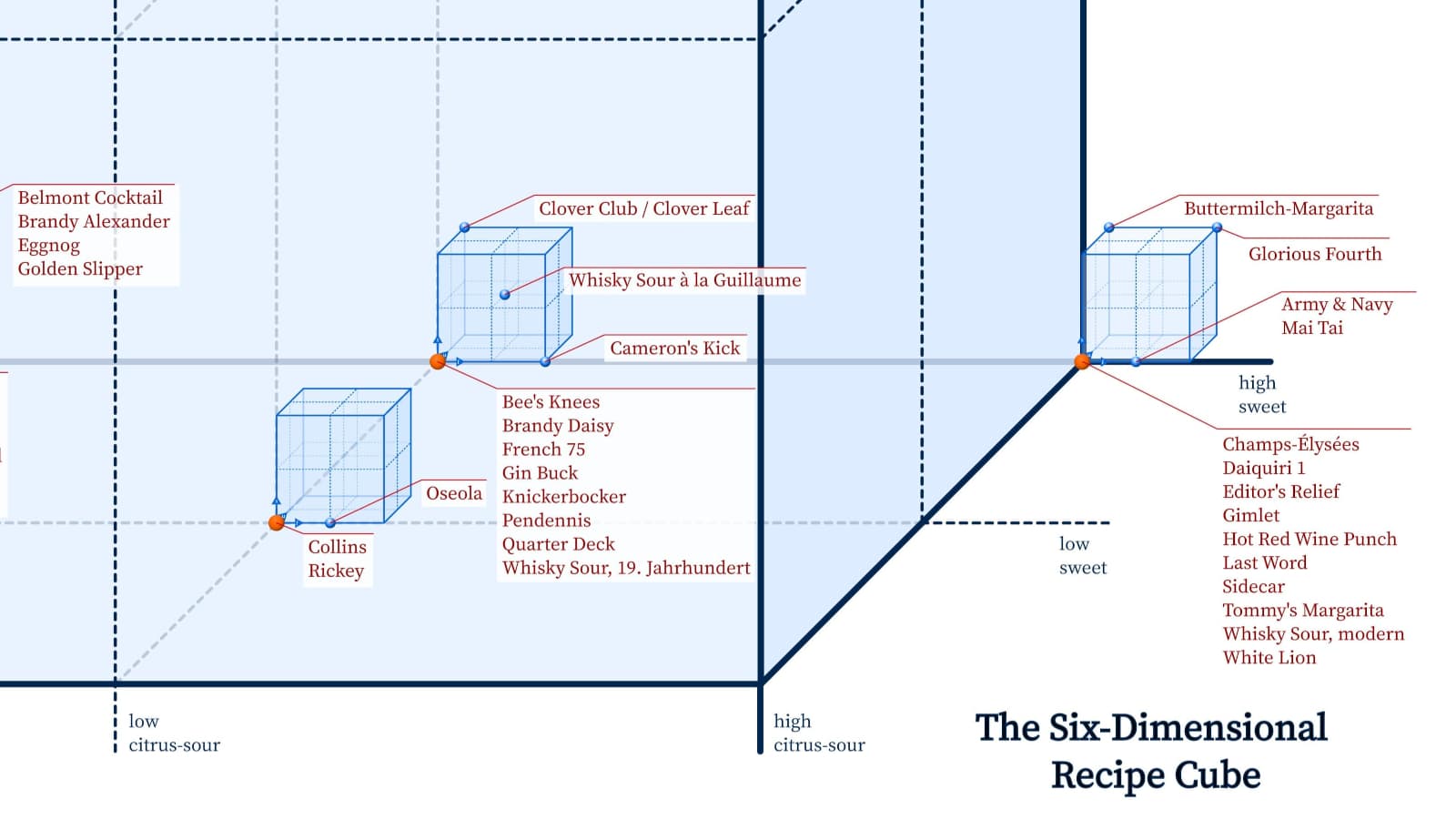
The following figure shows a selection of mixed drinks with their corresponding globular cluster in the Six-Dimensional Recipe Cube. Unoccupied cubes have been hidden to provide a clearer overview. A more comprehensive collection of recipes, together with their corresponding globular clusters in the Recipe Cube, is available in the appendix.
Recipe cube containing examples of mixed drinks.
Interrelationships
It is interesting to see which mixed drinks function in a similar way despite their different recipes. When we examine and familiarise ourselves with each individual globular cluster in the Recipe Cube, we learn a great deal about the underlying interrelationships and why recipes that were traditionally divided into different categories actually belong together. It is only through this analysis that we gain a complete understanding.
Once mixed drinks are positioned within the Six-Dimensional Recipe Cube, the benefits become apparent: it becomes clear how they are interconnected.
Formula representation
A formula-based representation is also possible. The main cube is coded as follows:
C = citrus-sour as the x-axis
B = bitter as the y-axis
S = sweet as the z-axis
The intensity level ‘low’ is represented by a lower position.
The secondary cube is coded after a hyphen. Here,
F = fatty) as the x-axis
S = salty) as the y-axis
U =umami) as the z-Axis
The example ‘low bitter, high sweet, low umami’ would result in this formula:
BS|U
A new taxonomy
The Six-Dimensional Recipe Cube can easily be reconciled with a traditional taxonomy.
In the Recipe Cube, an item is first defined by its primary taste and then by its secondary taste. In a taxonomy, the primary taste forms the class, whilst the secondary taste forms the subclass. These two levels define the globular cluster in the Six-Dimensional Recipe Cube.
As an example, I would like to illustrate the structure of the taxonomy for a Manhattan cocktail:
I have deliberately chosen not to treat the secondary taste as an order, as both the main and secondary tastes are based on taste types. They differ only in that we weight them differently in the graphical representation.
Detailed taxonomic classification
A further taxonomic subdivision is useful. The globular cluster labelled ‘high bitter, high sweet’ includes, by definition: Gin & Tonic, Greenpoint, Perfect Martini, Negroni and Bijou. These examples clearly illustrate that, in addition to the taste types, we must also consider the ingredients of the recipes in order to establish an additional classification system geared towards practical utility. The fundamental functioning of the recipe is crucial here. The aim is to group together recipes that function in a similar way in a meaningful way.
A milestone is the invention of the Manhattan Cocktail, or more precisely, the idea of combining a spirit with a vermouth. This unleashed tremendous creativity and gave rise to countless recipes and variations. This turning point should therefore be reflected in the subsequent classification. I therefore propose distinguishing, at the level of order, whether a recipe contains no, little or a lot of bitter wine. As before, the threshold for this distinction is 15 per cent. From 15 per cent onwards, it is considered ‘high’; below that, ‘low’.
All wines to which bitterness has been added are classified as ‘bitter wine’. These include, for example: vermouth and quinine wines (or, to name a few brands: Cap Corse Quinquina, Dubonnet, Lillet).
In this way, we arrive at the order ‘no bitter wine’, which includes the gin and tonic; the order ‘low bitter wine’, which includes the Greenpoint; and the order ‘high bitter wine’, which includes the Perfect Martini, Negroni and Bijou. What remains is a sensible further subdivision of these last three, as their recipes differ sufficiently. What distinguishes them is not the bitter wine, but the quantity of other bitters. They should therefore be classified not only according to bitter wine, but also according to ‘other bitters’. Here, too, the 15 per cent threshold should be applied. A proportion of less than 15 per cent is ‘low’; from 15 per cent onwards, it is ‘high’. This distinguishes the Perfect Martini (‘high bitter wine, no other bitters’), the Bijou (‘high bitter wine, low other bitters’) and the Negroni (‘high bitter wine, low other bitters’) from one another.
The question of ‘bitter wine’ is therefore taxonomically situated at the order level, whilst the question of ‘other bitters’ is situated at the family level.
An additional clarification is required: this classification of orders and families applies not only to this particular order we have examined, but also to all other orders. In this respect, our taxonomy differs from the conventional one, as for our purposes it is important to have an easy-to-remember classification of all drinks. We cannot, therefore, allow a different sub-classification for each order. In concrete terms, this means that within all globular clusters, we first distinguish between ‘bitter wine’ and then ‘other bitters’.
Future research will need to determine which further subdivisions might be relevant: the question to be answered is according to which subordinate criteria the globular clusters of the Recipe Cube should be further subdivided in order to bring additional order to the matter. We need to clarify which fundamentally distinct recipe structures exist, and whether these can serve as a meaningful subordinate classification criterion. For this classification, the taxonomic levels of order, family and genus can be used.
There may be differing views, and taxonomists may well debate exactly which classification is ‘the right one’ – this is standard taxonomic work and a normal part of scientific discourse.
Appendix
Taste types of ingredients
The following list contains the most common ingredients, together with their relevant taste types for positioning within the Recipe Cube, based on important historical recipe collections, supplemented by a few used today. The selected books, listed by year of publication, are:
1891 William Schmidt – The Flowing Bowl
1900: Harry Johnson – The New and Improved Illustrated Bartenders‘ Manual.
1914: Jacques Straub – Drinks.
1917: Richard Hugo Ensslin – Recipes for Mixed Drinks.
1922: Robert Vermeire – Cocktails. How to Mix Them.
Classification of example mixed drinks in the Recipe Cube
The following list contains a selection of mixed drinks, showing their position in the Recipe Cube and the corresponding order and family. The sorting is as follows: within the main taste, first from bottom to top, then from left to right, then from front to back. If a secondary taste is also present, this is sorted in the same way.
Main taste, lower level
-|
No bitter wine, no other bitters: Bourbon Highball, Brandy & Soda, Grog, Parkeroo, Scotch & Soda, Turning World
CS|
No bitter wine, low other bitters: Collins, Mojito, Rickey
CS|F
No bitter wine, no other bitters: Oseola
S|
No bitter wine, no other bitters: Alexander 1908, Angel‘s Face, Aviateur, B&B, Black Hawk, Campbeltown Cocktail, Cus D’Amato, La Boëtie, Le Loriot, Montaigne, Negus (Port & Soda), Noble Cocktail, Peacock, Pleasant Surprise, Port Oporto, Professor Langnickel, Rapscallion, Roulette Cocktail, Savoy Tango, Stone Fence, Tinton Cocktail
S|FSU
No bitter wine, no other bitters: Hot Spiced Buttered Rum
S|FSU
No bitter wine, no other bitters: Coffee Cocktail
S|FSU
No bitter wine, no other bitters: Belmont Cocktail, Brandy Alexander, Eggnog, Golden Slipper, Hazlenut Alexander
CS|
No bitter wine, no other bitters: Bee’s Knees, Brandy Daisy, French 75, Gin Buck, Knickerbocker, Knickerbocker (Harry Johnson), Pendennis, Quarter Deck, Whisky Sour (19. Jahrhundert), Williams Sour
CS|F
No bitter wine, no other bitters: Cameron’s Kick
CS|FSU
No bitter wine, no other bitters: Whisky Sour à la Guillaume
CS|SU
No bitter wine, no other bitters: Clover Club / Clover Leaf
CS|
No bitter wine, no other bitters: Burning Apple Tree, Canchanchara, Champs-Élysées, Charlie Chaplin, Daiquiri 1, Dinah, Editor’s Relief, Esplanade Praha, Gimlet, Hot Red Wine Punch, Last Word, Oaxaca‘s Word, Sidecar, Tommy’s Margarita, Upstairs, Whisky Sour (modern), White Lion
CS|F
No bitter wine, no other bitters: Army & Navy, Mai Tai
CS|SU
No bitter wine, no other bitters: Buttermilch-Margarita, Smokey Mothball
CS|FSU
No bitter wine, no other bitters: Glorious Fourth
Main taste, medium level
B|
No bitter wine, low other bitters: Hanover House Cocktail, Holland House Cocktail, Tussetto
BS|
No bitter wine, low other bitters: Oaxaca Old-Fashioned, Phoenix, Sazerac, Up-To-Date Cocktail, Whisky Cocktail (& Old-Fashioned), Whisky Cocktail à la Guillaume, Ye Olde English Cocktail
BS|
No bitter wine, low other bitters: Alberti’s Night Cocktail, Antidot Cocktail, Betsy Ross, Daughter of the Dawn “Dewey”, East India Cocktail, Princeton, The Peated Dutchman, Vanderbilt
BS|F
No bitter wine, low other bitters: Japanese Cocktail
CBS|
No bitter wine, low other bitters: Brandy Crusta, Kurfürstendamm
CBS|
No bitter wine, low other bitters: Biter, Flor de Jerez
CBS|SU
No bitter wine, low other bitters: Morning Glory Fizz
Main taste, upper level
B|
Kein Bitterwein, Viel andere Bitter: Story Cocktail
BS|
No bitter wine, low other bitters: Bicycle
No bitter wine, high other bitters: Gin & Tonic, Toronto
low bitter wine, no other bitters: Diplomat Cocktail, Esplanade Spezial, Georgetown Club Cocktail, Good Morning, Red Widow
low bitter wine, low other bitters: Attention Cocktail, Bamboo Cocktail #2, Daughter of the Dawn 1896, Greenpoint, Manhattan »à la Guillaume«, Martinez »a la Guillaume«
high bitter wine, no other bitters: Affinity, Aviation 1912, Bobby Burns, Brainstorm, Bronx, Brooklyn, Chambéry Fraisette, Chase, Claridge Cocktail, Crescent, Föhr-Manhattan, Humboldt, La Rafale, Metaxa, Perfect Martini, Pompier, Quartier Latin, Rio Grande, Lambs Club Cocktail, Rose, Zaza Cocktail
high bitter wine, low other bitters: Adonis Cocktail, Americano, Americano Fernet, Bamboo Cocktail #1, Bijou, Boulevardier 1929, Chrysanthemum, Daughter of the Dawn of the Twentieth Century, Deshler Cocktail, Dunhill’s Special, El Presidente, Hanky Panky, Star (Klondike), Manhattan (fr.), Manhattan (it.), Martini, Martini (Kappeler), Meehoulong Cocktail, Negroni Highball, Ohio, Rob Roy, The Anticipation, Vermouth Cocktail, Vermouth Cocktail ›à la Guillaume‹
high bitter wine, high other bitters: Boulevardier, Columbus Cocktail, Negroni
BS|U
high bitter wine, no other bitters: Kleginite
BS|S
high bitter wine, no other bitters: Dirty Martini, Kapernikus
CBS|
low bitter wine, no other bitters: Adlon Spezial
high bitter wine, no other bitters: Dubonnet Citron
CBS|
no bitter wine, low other bitters: Daiquiri 3, Diki-Diki-Cocktail
low bitter wine, no other bitters: Twentieth Century


Summary
A new classification system for mixed drinks is proposed. Each mixed drink is positioned within a Six-Dimensional Recipe Cube. The axes of this cube are the taste categories ‘citrus-sour’, ‘bitter’, ‘sweet’, ‘salty’, ‘umami’ and ‘fatty’. Each axis indicates the percentage of the recipe’s total ingredient quantity that possesses the corresponding taste type. To facilitate comparison, the drinks are grouped into globular clusters: the presence of a taste type is either absent, or is considered ‘low’ at up to 15 per cent and ‘high’ at 15 per cent or above. All drinks in the same globular cluster form a separate category. For the ingredients of the mixed drink, it is determined for each ingredient whether it contains taste types relevant for positioning within the recipe cube. The ingredient is
‘umami’, if it contains more than 30 mg of glutamic acid per 100 ml;
To facilitate a meaningful further classification, the mixed drinks in a globular cluster are first categorised according to the presence of bittered wine, and then according to other bitters. Here too, a distinction is made between ‘low’ (up to 15 per cent) and ‘high’ (15 per cent and above).
Traditional classification
As early as the 19th century, attempts were made to classify mixed drinks and group them into similar categories. However, there were always exceptions and variations. A clear definition never existed, and so there was repeated confusion as to what exactly, for example, a punch, a toddy, a grog or a cocktail actually was.
In the years that followed, numerous attempts were made to remedy these shortcomings. These represent valuable contributions to the theory of mixed drinks. The authors demonstrate their endeavour to understand and convey the internal structure of the drinks. Their approach consists of grouping similar items together: once one understands how the individual ingredients function in a drink within a group, this insight can easily be applied to the other members of that group.
The diversity of their attempts at categorisation shows that this endeavour is not as straightforward as it might seem. To date, no generally accepted classification system has been established.
I am not convinced by the proposals put forward so far. To summarise broadly and put it succinctly, these are the reasons that are present to a greater or lesser extent in all the proposals:
In some cases, drinks are assigned to several groups at the same time.
This may seem like an exaggerated criticism, but the very definition of the classification must be clear and unambiguous. Another problem lies in the fact that categorisation tends to be based on exclusion, which creates many grey areas. The boundaries, on the other hand, are fluid and almost arbitrary, so that a sharp, clear-cut distinction seems to me to be very difficult, if not impossible.
For a better understanding, like should be grouped with like, and within a single category. When classifying and organising things into clear structures, there should be no ‘both-and’.
Mere criticism without an alternative proposal is all too easy. I would therefore like to propose a new theory of mixed drinks for discussion, one that avoids the problems mentioned and reflects the complexity of all drinks. It is based on a scientific foundation. This is absolutely essential, for without such a foundation, any further approach is doomed to failure.
Scientific base
To bring some order to mixed drinks, a new approach must be found: the solution to the problem lies in the way we perceive our environment.
Our senses form the basis of our perception. We use our senses to judge whether we like the taste of something. When considering our senses from a scientific perspective, we must make a clear distinction between the sense of taste, the sense of smell and trigeminal stimuli. In everyday language, this distinction is not always made.
The mouth contains taste receptors for sweet, sour, salty, bitter, umami and fatty. There may also be receptors for starch, calcium, metallic and alkaline tastes. However, I shall not consider these latter ones further in the following discussion. The trigeminal nerve transmits sensations such as hot, cold, caustic, pungent, burning, tingling and astringent. The sense of smell, which perceives aromas and scents, is located in the nose.
The precise functioning of the sense of smell, the sense of taste and the trigeminal nerve will not be explained here. This will be the subject of a later publication. In what follows, I shall merely summarise my findings.
The Six-Dimensional Taste Space
To group similar drinks meaningfully, it is sufficient to consider the sense of taste.
The elements of the sense of taste can be regarded as dimensions within which a mixed drink is situated. I consider the taste categories of sour, bitter, sweet, fatty, salty and umami to be the decisive dimensions for classifying a mixed drink. These taste categories span a multidimensional space, which I would like to call the ‘Six-Dimensional Taste Space’.
In the Six-Dimensional Taste Space, the individual axis values are determined by actual intensities that can be measured in the laboratory.
Consequently, each mixed drink is assigned a position within this multidimensional feature space, determined by vector coding, based on its taste characteristics.
The exact position of a drink within the Taste Space can only be determined through laboratory analysis. Whilst such a measurement is scientifically accurate, it is impractical for real-world applications. It would be desirable if, when looking at a recipe, it were possible to recognise quickly and intuitively which recipes are similar to one another and therefore belong to the same group of drinks. We therefore need a simple and understandable guide that allows us to instantly place a mixed drink in its appropriate category.
The Six-Dimensional Recipe Cube
The aim is to group similar recipes together quickly and intuitively. To achieve this, we need to simplify matters. This simplification inevitably means that we must move away from the Taste Space outlined earlier and switch to the Recipe Cube, which operates according to comparable principles.
The distinction between the Taste Space and the Recipe Cube is a key point, and I would like to emphasise the significance of this distinction: a drink’s position in the Taste Space is based on an analysis of all the taste types present in the drink and is determined by the actual intensity of a taste stimulus. This can only be determined using laboratory techniques.
The Recipe Ccube is defined differently. It is not about the actual intensities of a particular taste. Instead, a taste’s position on the axis is determined by answering the question: what percentage of the recipe’s ingredients possess that taste? This means that, in the Recipe Cube, we can dispense with laboratory analyses.
I would like to illustrate this with an example. Let us consider a Martini Cocktail, which is made solely from gin and vermouth. Vermouth is ‘sweet’ and ‘bitter’, whilst gin has no taste dimension.
If the recipe consists of half vermouth, the Martini is positioned on the ‘sweet’ axis at 50 per cent in the Recipe Cube. A Martini with one part gin and two parts vermouth lies at 66.66 per cent. A so-called Montgomery Martini, made with 15 parts gin and one part vermouth, lies at 6.25 per cent. On the ‘sweet’ taste axis, the various Martini variants are therefore positioned as follows:
This approach differs fundamentally from the Taste Space. Suppose we had gone to the trouble of determining the sugar content of the vermouth in the laboratory. Then, for example, Noilly Prat Extra Dry would have a residual sugar content of 24 g/l, whilst Carpano Antica Formula would have 194 g/l. They differ by a factor of 8. In the Taste Space, this would result in very different positions on the ‘sweet’ dimension for a 1:1 Martini, depending on the vermouth used. In the Recipe Cube, however, both occupy the same position, as the recipe works the same way: one part gin and one part vermouth.
The taste types of ingredients
The position of a mixed drink within the Recipe Cube is determined by the taste types present in the ingredients. We must therefore answer the question of when a taste type is present in an ingredient.
To be able to make a qualified statement, we must consider the various dimensions separately. Basic principles such as perception thresholds or the dissociation of acids must be taken into account. For each taste type, we must determine a threshold value. If this is exceeded, the taste type is considered to be present in the ingredient.
Dimension: ‘sweet’
I would like to provide a pragmatic answer to the question of the threshold above which an ingredient is no longer considered ‘sugar-free’, by referring to EU Regulation 1924/2006. It states: “A claim that a food is sugar-free, and any claim likely to have the same meaning for the consumer, may only be made
where the product contains no more than 0,5 g of sugar per 100 g or 100 ml.” Consequently, an ingredient containing less than 5 g/l of sugar may be labelled as ‘sugar-free’ and therefore has no ‘sweet’ dimension.
We must expand this basic definition to include an important addition and specify that, for the purposes of our discussion, a distillate is always unsweetened. This is important because, whilst the addition of sugar to distillates is legally permitted, it is not a natural component. This is often the case with rum or cognac, for example.
We therefore assume, for the purposes of our discussion, that the recipes refer to an unsweetened distillate. Of course, there are exceptions to this rule. Gin should be regarded as unsweetened, whereas Old Tom gin should be regarded as sweetened, as the addition of sugar defines the Old Tom gin category. So, if a recipe explicitly calls for Old Tom, we know that the author of the recipe has placed importance on the sugar it contains.
We should adhere to the following guiding principle: a distillate is always considered unsweetened (with rare exceptions, such as Old Tom Gin).
Based on this definition, the following selected ingredients are to be regarded as ‘sweet’, as they exceed the threshold. I have included a more detailed list in the appendix.
Dimension: ‘bitter’
With the ‘bitter’ dimension, the problem lies in precisely defining, amongst the ingredients used, which of them should be regarded as ‘bitter’ in the Recipe Cube.
Many ingredients contain bitter compounds; there is no EU regulation on this, and given the wide variety of bitter compounds with vastly differing levels of bitterness, there are a number of factors to bear in mind.
For example, should basil or mint be considered ‘bitter’? I do not think so, as both are added – despite containing bitter compounds – mainly for aromatic reasons or to stimulate the trigeminal nerve, rather than to impart a bitter flavour to a mixed drink.
The numerous herbal liqueurs also pose a problem. Which of them can truly be regarded as ‘bitter’? Certainly not Chartreuse and Bénédictine, and even the old masters evidently saw it that way: Harry Johnson was the first to publish the recipe for a Bijou cocktail. For him, whilst the green Chartreuse clearly added herbal notes, the absence of bitter notes meant he also used an orange cocktail bitter. If it were merely a question of orange flavours, Harry Johnson would have used Curaçao instead. The same applies to the Champs-Élysées from the 1920s: Angostura bitters must be used in addition to the green Chartreuse. Another example: the Golden Slipper and the B&B are very much in the tradition of layered Pousse Cafés, which always call for sweetness, not bitterness. It is clear that Chartreuse and Bénédictine should be regarded as ‘sweet’, but not as ‘bitter’.
We must note that only genuine bitters and bitter liqueurs are to be understood as ‘bitter’ in the Recipe Cube. These include, for example, ‘Dutch bitters’ (such as Campari or La Canellese Original Bitter), absinthe, Fernet, stomach bitters, cocktail bitters and Boonekamp. Also bitter are quinine and vermouth wines, Indian tonic water and grapefruit juice.
Dimension: ‘sour’
Examining the ‘sour’ dimension presents a few problems. This is due to the dissociation and degree of dissociation of acids, and the associated issue that measuring the pH value is not a suitable way of determining how sour something tastes.
Furthermore, the pH values inherent in the ingredients make matters complicated. To give an example: the pH value of lemon juice lies between 2 and 2.6. There are some unaged brandies that also have a pH value of 2.6; this makes them just as sour as lemon juice.
We need to simplify matters in order to arrive at a meaningful and practical grouping within the Recipe Cube. pH values and dissociation may play a role in the flavour profile, but within the Recipe Cube they are a hindrance. There is, however, a simple solution to the problem: when it comes to the essence of a mixed drink, what matters to me is not how low its pH value is, but whether it has been prepared with citrus juices. If, therefore, we limit ourselves to citrus juices for the ‘sour’ dimension when positioning drinks in the Recipe Cube, this results in meaningful groups of mixed drinks. This does not mean that, when designing a drink, we should not bear in mind that different ingredients have varying degrees of acidity and can significantly influence the taste experience. However, our aim here is to group recipes that function in a similar way within the Recipe Cube. It therefore makes sense not to ask about the acidity level of an ingredient, but rather about the presence of citrus juices – in other words, essentially only about the acidity derived from them. For this reason, I would like to change the name of the axis for the taste type ‘sour’ in the recipe cube to ‘citrus-sour’.
This also means that, in our assessment, we do not limit ourselves to strong sources of acidity such as lime or lemon. We can also include orange and grapefruit, even though their pH value is significantly higher.
This approach means that so-called ‘citrus substitutes’ such as verjus or ‘superjuice’ – a mixture of various acids intended to imitate citrus juices – always lie at the zero point on the ‘citrus-sour’ axis, as they are not citrus juices.
No exceptions should be made for these ingredients, as this would take us back to the problem of pH values and dissociation described earlier. However, this is not a fault in the Recipe Cube – after all, drinks containing citrus juice are meant to be grouped there; therefore, recipes without citrus juice cannot occupy the same position. Furthermore, I would like to point out that anyone who has ever tasted high-quality lemon juice made from Ligurian fruit knows that this flavour cannot be artificially replicated. Citrus fruits are more than just a collection of a few acids; they possess a complex flavour profile.
Dimension: ‘fatty’
EU Regulation 1924/2006 helps us to establish a threshold above which we can say that a mixed drink contains fat: “A claim that a food is fat-free, and any claim likely to have the same meaning for the consumer, may only be made where
the product contains no more than 0,5 g of fat per 100 g or 100 ml. However, claims expressed as ‘X % fat-free’ shall be prohibited.”
Consequently, cream and egg yolk are ‘fatty’.
Orgeat is a special case. The industrially produced orgeat available today is, in principle, nothing more than a sugar syrup flavoured with flavourings. One made according to a traditional recipe differs from this, as it also contains fat. This means that in old mixed drinks, the original recipe used a fatty orgeat. Therefore, these should always be regarded as ‘fatty’ in the Recipe Cube. In the case of modern recipes whose original recipe is based on industrially produced orgeat, one should perhaps take this into account and position them more in the fat-free range. However, I would like to make a critical point: the fact that orgeat is not produced correctly on an industrial scale must not lead us to deny that orgeat is fatty. We should instead switch to a different product.
Dimension: ‘salty’
EU Regulation 1924/2006 stipulates: “A claim that a food is sodium-free or salt-free, and any claim likely to have the same meaning for the consumer, may only
be made where the product contains no more than 0,005 g of sodium, or the equivalent value for salt, per 100 g.”
Consequently, buttermilk, egg yolk, egg white and cream are all considered ‘salty’.
Dimension: ‘umami’
The perception threshold for umami is 30 mg of glutamic acid per 100 ml. Taking into account that aspartic acid also has an umami taste and is detected by the same receptors, it follows that the following ingredients are ‘umami’: cream, buttermilk, egg white and egg yolk.
Sherry is not umami; it merely enhances the perception of umami. Sake, on the other hand, I generally regard as a source of umami, even though there are examples where the glutamate content lies below the perception threshold. Such a generalisation is permissible and necessary, as we do not have laboratory analyses for every single ingredient in the Recipe Cube.
Grouping in the Recipe Cube
Having defined when a taste type in an ingredient is relevant for positioning within the Recipe Cube, we must also consider how recipes can be categorised and grouped effectively within the Recipe Cube. For example, it makes a big difference whether a drink contains a little or a lot of lemon juice, which is why drinks should be divided into ‘not citrus-sour’, ‘low citrus-sour’ and ‘high citrus-sour’. The same applies to all other taste types.
What is the advantage of this? To stick with lemon juice as an example: all drinks containing citrus juice are then no longer scattered along the citrus acidity axis with a value between 0 and 100 according to their percentage of citrus juice, but are instead grouped into just three categories labelled ‘not citrus-sour’, ‘low citrus-sour’ and ‘high citrus-sour’.
If one applies the same approach to the other taste types, all similar drinks lie within a common six-dimensional globular cluster.
I am using the term ‘globular cluster’ for illustrative purposes, as it is comparable to the three-dimensional globular star clusters found in astronomy. Wikipedia describes it as follows: “A globular cluster is a cluster of stars consisting of a large number of stars bound together by gravity, whose density exhibits a spherically symmetric distribution, decreasing equally in all directions from the centre – where the stars are very densely packed – towards the edge.” [2]
After this digression into astronomy, let us return to the globular clusters of the Recipe Cube: all drinks that are similar to one another are located in the same place, within the same globular cluster; however, if one approaches the globular cluster and looks more closely, the drinks within it are all slightly separated from one another, depending on the percentage of each taste type. For our purposes of grouping and understanding how individual drinks are related to one another and how they resemble each other, it is sufficient to consider the globular clusters. Drinks located within a globular cluster belong to the same category due to their flavour similarities: each globular cluster forms a distinct category.
Distinguishing between the globular clusters
How can we determine, within the Recipe Cube, whether the quantity specified in a recipe is ‘low’ or ‘high’? Where does one category begin, and where does the other end?
In answering these questions, we can only refer to the quantities specified in the recipe. At best, we can take inspiration from examples of mixed drinks. In doing so, we should always base our assessment on the recipe without dilution. The reason for this is that meltwater is not specified in the recipes, and we should not attempt to calculate it, especially as the quantity depends heavily on the method of preparation. In any case, it is not possible to draw a precise dividing line. The boundaries between ‘low’ and ‘high’ are fluid.
I do not wish to bore anyone, so I shall refrain from providing annotated examples. My analysis of the various recipes revealed that, across all parameters, a proportion below 15 per cent should be regarded as ‘low’, and 15 per cent or more as ‘high’. This provides sensible distinctions, and moreover, 15 per cent is relatively easy to calculate in one’s head.
Nevertheless, to illustrate the point, I would like to consider a Whisky Cocktail as an example: made with 60 ml of whisky, 5 ml of sugar syrup and 2.5 ml (2 dashes) of bitters. Which globular cluster does it fall into?
If we look back once more at the various Martini variations I mentioned at the beginning, we can see that:
The other two Martinis, with one or two parts vermouth to one part gin, fall within the ‘high bitter, high sweet’ cluster.
Graphical representation of the Recipe Cube
How can we represent the Six-Dimensional Recipe Cube, with its globular clusters, effectively on a sheet of paper?
To me, the three most important dimensions seem to be ‘citrus-sour’, ‘bitter’ and ‘sweet’. These therefore form the X, Y and Z axes of the main cube, and I would therefore like to refer to them as the ‘main taste’. For these dimensions, there is a distinction between ‘low’ and ‘high’. This results in the orange positions shown in the following diagram, which correspond to the associated globular clusters.
At each of these positions, a further, smaller secondary cube unfolds, defined by the dimensions ‘fatty’, ‘salty’ and ‘umami’ as ‘additional’ x-, y- and z-axes; I would like to refer to these taste types as ‘secondary taste’. For these dimensions, too, there is a distinction between ‘low’ and ‘high’. This results in the additional blue positions, which also correspond to globular clusters.
As an example, I’ll select the option ‘high citrus-sour, high sweet’ from the Recipe Cube to show how drinks are categorised:
The following figure shows a selection of mixed drinks with their corresponding globular cluster in the Six-Dimensional Recipe Cube. Unoccupied cubes have been hidden to provide a clearer overview. A more comprehensive collection of recipes, together with their corresponding globular clusters in the Recipe Cube, is available in the appendix.
Interrelationships
It is interesting to see which mixed drinks function in a similar way despite their different recipes. When we examine and familiarise ourselves with each individual globular cluster in the Recipe Cube, we learn a great deal about the underlying interrelationships and why recipes that were traditionally divided into different categories actually belong together. It is only through this analysis that we gain a complete understanding.
Once mixed drinks are positioned within the Six-Dimensional Recipe Cube, the benefits become apparent: it becomes clear how they are interconnected.
Formula representation
A formula-based representation is also possible. The main cube is coded as follows:
The intensity level ‘low’ is represented by a lower position.
The secondary cube is coded after a hyphen. Here,
The example ‘low bitter, high sweet, low umami’ would result in this formula:
BS|U
A new taxonomy
The Six-Dimensional Recipe Cube can easily be reconciled with a traditional taxonomy.
In the Recipe Cube, an item is first defined by its primary taste and then by its secondary taste. In a taxonomy, the primary taste forms the class, whilst the secondary taste forms the subclass. These two levels define the globular cluster in the Six-Dimensional Recipe Cube.
As an example, I would like to illustrate the structure of the taxonomy for a Manhattan cocktail:
Domain: Beverages
Kingdom: Mixed drinks
Phylum: Alcoholic mixed drinks
Class: Main taste (‘high bitter, high sweet’)
Subclass: Secondary taste (‘no secondary taste’)
Order: –
Family: –
Genus: –
Species: Manhattan
Subspecies: dry
Subspecies: sweet
I have deliberately chosen not to treat the secondary taste as an order, as both the main and secondary tastes are based on taste types. They differ only in that we weight them differently in the graphical representation.
Detailed taxonomic classification
A further taxonomic subdivision is useful. The globular cluster labelled ‘high bitter, high sweet’ includes, by definition: Gin & Tonic, Greenpoint, Perfect Martini, Negroni and Bijou. These examples clearly illustrate that, in addition to the taste types, we must also consider the ingredients of the recipes in order to establish an additional classification system geared towards practical utility. The fundamental functioning of the recipe is crucial here. The aim is to group together recipes that function in a similar way in a meaningful way.
A milestone is the invention of the Manhattan Cocktail, or more precisely, the idea of combining a spirit with a vermouth. This unleashed tremendous creativity and gave rise to countless recipes and variations. This turning point should therefore be reflected in the subsequent classification. I therefore propose distinguishing, at the level of order, whether a recipe contains no, little or a lot of bitter wine. As before, the threshold for this distinction is 15 per cent. From 15 per cent onwards, it is considered ‘high’; below that, ‘low’.
All wines to which bitterness has been added are classified as ‘bitter wine’. These include, for example: vermouth and quinine wines (or, to name a few brands: Cap Corse Quinquina, Dubonnet, Lillet).
In this way, we arrive at the order ‘no bitter wine’, which includes the gin and tonic; the order ‘low bitter wine’, which includes the Greenpoint; and the order ‘high bitter wine’, which includes the Perfect Martini, Negroni and Bijou. What remains is a sensible further subdivision of these last three, as their recipes differ sufficiently. What distinguishes them is not the bitter wine, but the quantity of other bitters. They should therefore be classified not only according to bitter wine, but also according to ‘other bitters’. Here, too, the 15 per cent threshold should be applied. A proportion of less than 15 per cent is ‘low’; from 15 per cent onwards, it is ‘high’. This distinguishes the Perfect Martini (‘high bitter wine, no other bitters’), the Bijou (‘high bitter wine, low other bitters’) and the Negroni (‘high bitter wine, low other bitters’) from one another.
The question of ‘bitter wine’ is therefore taxonomically situated at the order level, whilst the question of ‘other bitters’ is situated at the family level.
An additional clarification is required: this classification of orders and families applies not only to this particular order we have examined, but also to all other orders. In this respect, our taxonomy differs from the conventional one, as for our purposes it is important to have an easy-to-remember classification of all drinks. We cannot, therefore, allow a different sub-classification for each order. In concrete terms, this means that within all globular clusters, we first distinguish between ‘bitter wine’ and then ‘other bitters’.
Future research will need to determine which further subdivisions might be relevant: the question to be answered is according to which subordinate criteria the globular clusters of the Recipe Cube should be further subdivided in order to bring additional order to the matter. We need to clarify which fundamentally distinct recipe structures exist, and whether these can serve as a meaningful subordinate classification criterion. For this classification, the taxonomic levels of order, family and genus can be used.
There may be differing views, and taxonomists may well debate exactly which classification is ‘the right one’ – this is standard taxonomic work and a normal part of scientific discourse.
Appendix
Taste types of ingredients
The following list contains the most common ingredients, together with their relevant taste types for positioning within the Recipe Cube, based on important historical recipe collections, supplemented by a few used today. The selected books, listed by year of publication, are:
Ingredient
Taste types
absinthe
bitter
agave syrup
sweet
allspice
.
allspice liqueur
sweet
amer picon
sweet, bitter
angostura bitters → cocktail bitters
bitter
anisée → aniseed liquor
sweet
aniseed liquor (e.g. anisée, anisette)
sweet
aniseed syrup
sweet
anisette → aniseed liquor
sweet
apollinaris → soda water
.
apple brandy
eau-de-vie/geist . / liqueur sweet
apple eau-de-vie (e.g. calvados)
.
applejack
.
apricot brandy
eau-de-vie/geist . / liqueur sweet
apricot eau-de-vie (marille)
.
apricot liqueur
sweet
apricotine → apricot liqueur
sweet
aprikot syrup
sweet
armagnac
.
arrak
.
assmannshäuser → wine
sweet
basil
.
bénédictine
sweet, bitter
bitter
sweet, bitter
bitter liqueur
bitter
bitter orange geist
.
black tea
bitter (depending on the variety)
black-currant-liqueur (crème de cassis)
sweet
blackberry brandy (→ blackberry eau-de-vie, blackberry geist, blackberry liqueur)
eau-de-vie/geist . / liqueur sweet
blackberry eau-de-vie or geist
.
blackberry liqueur
sweet
boker’s bitters → cocktail bitters
bitter
boonekamp (e.g. petrus, underberg)
bitter
bordeaux → wine
sweet
bourbon → whisky
.
brandy (wine spirit)
.
burgundy → Wein
sweet
butter
sweet, fatty, salty, umami
buttermelk
sweet, salty, umami
byrrh
sweet, bitter
calisaya
sweet, bitter
caloric punch → swedish punch
sweet
calvados (aged, → apple eau-de-vie)
.
calvados (unaged, → apple eau-de-vie)
.
campari → Dutch bitter
sweet, bitter
cap corse → quinine wine
sweet, bitter
caperitif → quinine wine
sweet, bitter
capers lake
salty
capillaire
sweet
carbonated water → soda water
.
carlshamns flaggpunch → swedish punch
sweet
cederlund’s punch → swedish punch
sweet
celery citters → cocktail bitters
bitter
champagne
sweet
chartreuse
sweet
cherry brandy (→ cherry eau-de-vie)
eau-de-vie/geist . / liqueur sweet
cherry cordial
sweet
cherry eau-de-vie
.
cherry juice
sweet
cherry liqueur
sweet
chianti → Wine
sweet
chocolate geist
.
cider
sweet
cinamon liqueur
sweet
cinnamon
.
clairin → rum
.
claret → wine
sweet
clove
.
clove syrup
sweet
cocktail bitters (e.g. angostura, boker’s, orinoco, peychaud, celery, hostetter, orange, peach, pepsin)
bitter
cocoa liqueur (crème de cacao)
sweet
coffee
bitter
cognac
.
cointreau → triple sec
sweet
combier → triple sec
sweet
cream
sweet, fatty, salty, umami
curaçao
sweet
cynar
sweet, bitter
Danziger Goldwasser
sweet
drambuie
sweet
dubonnet → quinine wine
sweet, bitter
Dutch bitter (e.g. campari, la canellese Bitter)
sweet, bitter
eau-de-vie
.
egg white
salty, umami
egg yolk
fatty, salty, umami
elixier combier
sweet
falernum
sweet
fernet
sweet, bitter
frontignan → wine
sweet
geist
.
genever (Holland gin)
.
gentian liqueur
sweet, bitter
gin
.
ginger ale
sweet
ginger beer
sweet
ginger brandy
eau-de-vie/geist . / liqueur sweet
gomme syrup → sugar syrup
sweet
gooseberry syrup
sweet
grand marnier → triple sec
sweet
grapefruit juice
sweet, bitter, citrus-sour
grapefruit marmalade
sweet, bitter, citrus-sour
grapefruit zest
.
grapefruit zest (muddeled)
bitter
green tea
bitter (depending on the variety)
grenadine syrup
sweet
gum syrup → sugar syrup
sweet
hazlenut geist
.
herbal liqueur
sweet
Holland gin → genever
.
honey
sweet
hostetter bitters → cocktail bitters
bitter
ice cream
sweet, fatty, salty, umami
indian tonic water (tonic water)
sweet, bitter
irish → whisky
.
kina → quinine wine
sweet, bitter
kirschwasser → cherry eau-de-vie
.
kümmel
sweet
la canellese bitter → Dutch bitter
sweet, bitter
lavender syrup
sweet
lemon juice
sweet, citrus-sour
lemon syrup
sweet, citrus-sour
lemon zest
.
lillet → quinine wine
sweet, bitter
lime juice
sweet, citrus-sour
madeira → wine
sweet
mandarin eau-de-vie
.
mandarin geist
.
mandarin juice
citrus-sour
mandarin liqueur (crème de mandarine, mandarinette), with mandarin juice as a base
sweet, citrus-sour
maple syrup
sweet
maraschino
sweet
mezcal
.
milk
sweet, fatty, salty, umami
mint
.
mint essence
.
mint liqueur (crème de menthe)
sweet
mint liqueur (crème de menthe)
sweet
molasses
sweet
mosel → wine
sweet
noyeau, crème de noyeau
sweet
nutmeg
.
old tom gin
sweet
olive lake
salty
orange bitters → cocktail bitters
bitter
orange blossom water
.
orange eau-de-vie
.
orange geist
.
orange liqueur → triple sec
sweet
orange marmalade
sweet, citrus-sour
orange zest
.
orangen juice
sweet, citrus-sour
orgeat, modern as sugar syrup
sweet
orgeat, traditional
sweet, fatty
orinoco bitters → cocktail bitters
bitter
parfait d’amour
sweet
peach bitters → cocktail bitters
bitter
peach brandy
eau-de-vie/geist . / liqueur sweet
pear eau-de-vie (e.g. williams, Wahlsche Schnapsbirne)
.
pepsin bitters → cocktail bitters
bitter
perrier → soda water
.
petrus boonekamp → boonekamp
bitter
Peychaud’s bitters → cocktail bitters
bitter
pineapple juice
sweet
pineapple syrup
sweet
plum syrup
sweet
plymouth gin
.
port wine
sweet
quince jelly
sweet
quinine wine (e.g. kina, quinquina, vino chinato, cap corse, dubonnet, lillet, caperitif)
sweet, bitter
quinquina → quinine wine
sweet, bitter
raspberry liqueur
sweet
raspberry syrup
sweet
redcurrant juice
sweet
redcurrant syrup
sweet
rhein → wine
sweet
rhum agricole → rum
.
rock candy syrup → sugar syrup
sweet
rose liqueur (crème de rose)
sweet
rose’s lime juice cordial
sweet, citrus-sour
rum (rum, clairin, rhum agricole)
.
rye → whisky
.
sake
sweet, umami
salt
salty
sauterne → wine
sweet
scotch → whisky
.
selters → soda water
.
sherry (fino, manzanilla, amontillado, oloroso)
.
sherry (PX)
sweet
sloe gin
sweet
soda water (e.g. apollinaris, carbonated water, perrier, selters, sparkling mineral water, sparkling water, vichy)
.
sparkling mineral water → soda water
.
sparkling water → soda water
.
strawberry juice
sweet
strawberry syrup
sweet
strega
sweet
sucker → sugar syrup
sweet
sugar syrup (e.g. gomme syrup, gum syrup, rock candy syrup)
sweet
swedish punch (e.g. cederlund’s punch, caloric punch, carlshamns flaggpunsch)
sweet
tansy
bitter
tequila
.
tokay → wine
sweet
tomato juice
sweet, umami
tonic water → indian tonic water
sweet, bitter
triple sec (orange liqueur, e.g. combier, cointreau, grand marnier), without juice base
sweet
underberg → boonekamp
bitter
vanilla liqueur (crème de vanille)
sweet
vanilla syrup
sweet
verjus
.
vermouth
sweet, bitter
vichy → soda water
.
vinegar
.
vino chinato → quinine wine
sweet, bitter
violet liqueur (crème de violette)
sweet
violet syrup
sweet
Wahlsche Schnapsbirne → pear eau-de-vie
.
water
.
whisky (scotch, bourbon, rye, irish, etc.)
.
williams > peach eau-de-vie
.
wine (frontignan, madeira, mosel, rhein, tokay, claret, burgundy, bordeaux, chianti, sauterne, assmannshäuser)
sweet
wodka
.
yvette (crème de cvette)
sweet
Classification of example mixed drinks in the Recipe Cube
The following list contains a selection of mixed drinks, showing their position in the Recipe Cube and the corresponding order and family. The sorting is as follows: within the main taste, first from bottom to top, then from left to right, then from front to back. If a secondary taste is also present, this is sorted in the same way.
Main taste, lower level
-|
No bitter wine, no other bitters: Bourbon Highball, Brandy & Soda, Grog, Parkeroo, Scotch & Soda, Turning World
CS|
No bitter wine, low other bitters: Collins, Mojito, Rickey
CS|F
No bitter wine, no other bitters: Oseola
S|
No bitter wine, no other bitters: Alexander 1908, Angel‘s Face, Aviateur, B&B, Black Hawk, Campbeltown Cocktail, Cus D’Amato, La Boëtie, Le Loriot, Montaigne, Negus (Port & Soda), Noble Cocktail, Peacock, Pleasant Surprise, Port Oporto, Professor Langnickel, Rapscallion, Roulette Cocktail, Savoy Tango, Stone Fence, Tinton Cocktail
S|FSU
No bitter wine, no other bitters: Hot Spiced Buttered Rum
S|FSU
No bitter wine, no other bitters: Coffee Cocktail
S|FSU
No bitter wine, no other bitters: Belmont Cocktail, Brandy Alexander, Eggnog, Golden Slipper, Hazlenut Alexander
CS|
No bitter wine, no other bitters: Bee’s Knees, Brandy Daisy, French 75, Gin Buck, Knickerbocker, Knickerbocker (Harry Johnson), Pendennis, Quarter Deck, Whisky Sour (19. Jahrhundert), Williams Sour
CS|F
No bitter wine, no other bitters: Cameron’s Kick
CS|FSU
No bitter wine, no other bitters: Whisky Sour à la Guillaume
CS|SU
No bitter wine, no other bitters: Clover Club / Clover Leaf
CS|
No bitter wine, no other bitters: Burning Apple Tree, Canchanchara, Champs-Élysées, Charlie Chaplin, Daiquiri 1, Dinah, Editor’s Relief, Esplanade Praha, Gimlet, Hot Red Wine Punch, Last Word, Oaxaca‘s Word, Sidecar, Tommy’s Margarita, Upstairs, Whisky Sour (modern), White Lion
CS|F
No bitter wine, no other bitters: Army & Navy, Mai Tai
CS|SU
No bitter wine, no other bitters: Buttermilch-Margarita, Smokey Mothball
CS|FSU
No bitter wine, no other bitters: Glorious Fourth
Main taste, medium level
B|
No bitter wine, low other bitters: Hanover House Cocktail, Holland House Cocktail, Tussetto
BS|
No bitter wine, low other bitters: Oaxaca Old-Fashioned, Phoenix, Sazerac, Up-To-Date Cocktail, Whisky Cocktail (& Old-Fashioned), Whisky Cocktail à la Guillaume, Ye Olde English Cocktail
BS|
No bitter wine, low other bitters: Alberti’s Night Cocktail, Antidot Cocktail, Betsy Ross, Daughter of the Dawn “Dewey”, East India Cocktail, Princeton, The Peated Dutchman, Vanderbilt
BS|F
No bitter wine, low other bitters: Japanese Cocktail
CBS|
No bitter wine, low other bitters: Brandy Crusta, Kurfürstendamm
CBS|
No bitter wine, low other bitters: Biter, Flor de Jerez
CBS|SU
No bitter wine, low other bitters: Morning Glory Fizz
Main taste, upper level
B|
Kein Bitterwein, Viel andere Bitter: Story Cocktail
BS|
No bitter wine, low other bitters: Bicycle
No bitter wine, high other bitters: Gin & Tonic, Toronto
low bitter wine, no other bitters: Diplomat Cocktail, Esplanade Spezial, Georgetown Club Cocktail, Good Morning, Red Widow
low bitter wine, low other bitters: Attention Cocktail, Bamboo Cocktail #2, Daughter of the Dawn 1896, Greenpoint, Manhattan »à la Guillaume«, Martinez »a la Guillaume«
high bitter wine, no other bitters: Affinity, Aviation 1912, Bobby Burns, Brainstorm, Bronx, Brooklyn, Chambéry Fraisette, Chase, Claridge Cocktail, Crescent, Föhr-Manhattan, Humboldt, La Rafale, Metaxa, Perfect Martini, Pompier, Quartier Latin, Rio Grande, Lambs Club Cocktail, Rose, Zaza Cocktail
high bitter wine, low other bitters: Adonis Cocktail, Americano, Americano Fernet, Bamboo Cocktail #1, Bijou, Boulevardier 1929, Chrysanthemum, Daughter of the Dawn of the Twentieth Century, Deshler Cocktail, Dunhill’s Special, El Presidente, Hanky Panky, Star (Klondike), Manhattan (fr.), Manhattan (it.), Martini, Martini (Kappeler), Meehoulong Cocktail, Negroni Highball, Ohio, Rob Roy, The Anticipation, Vermouth Cocktail, Vermouth Cocktail ›à la Guillaume‹
high bitter wine, high other bitters: Boulevardier, Columbus Cocktail, Negroni
BS|U
high bitter wine, no other bitters: Kleginite
BS|S
high bitter wine, no other bitters: Dirty Martini, Kapernikus
CBS|
low bitter wine, no other bitters: Adlon Spezial
high bitter wine, no other bitters: Dubonnet Citron
CBS|
no bitter wine, low other bitters: Daiquiri 3, Diki-Diki-Cocktail
low bitter wine, no other bitters: Twentieth Century
low bitter wine, high other bitters: Brain-Duster
Sources
explicit capitulum
*