To round off this series, we will look at how the British Navy Blend was most recently prepared and what its characteristics were.
The right blend?
An important account comes from P. Curtis, a former First Petty Officer. He demonstrates just how important the right blend was for Navy Rum. He recalls: “Here is a story of recent times by Mr P. Curtis, formerly a chief petty officer, to show just how important blending and taste have always been: ‘One invasion during the 1939-45 war which has never been sufficiently reported was the invasion of “foreign” rums from such places as Australia and South Africa. These foreign varieties were rejected by the older members of the ship’s company. As a dedicated tot drinker, and in my capacity as “chief pusser”, I did my best to satisfy my shipmates, by mixing pukka and foreign, but nothing compared with the original pusser’s to which we were accustomed. After the war, we still held large stocks of the foreign blends, particularly at Singapure where I happened to be, and so Their Lordships, in their infinite wisdom, decided that the superintending victualling store officer should ascertain the exact blend of rum most acceptable to the post-war navy. In HMS Terror, the shore base in Singapore, there were no less than six chief pussers serving at the same time. The SVSO had a brainwave – who better than those six to give an impartial but balanced judgement? Consequently the six of us mustered in his office, furnished with a large table, chairs, samples of rum from everywhere, with cheese, butter, dry biscuits, etc, for cleaning the palate after each sip. The normal method of judging wine is fourfold – the colour, the aroma or nose, the taste, and the aftertaste. Rum is different! As all old timers will know, the only way to drink a tot is to swallow it whole, grimace, and then sit down to appreciate the glow which spreads from the stomach and engenders that wonderful feeling of peace and general bonhomie. The tasting committee proceded with its task – probably the most enjoyable two hours that anyone could device! After a short period for recovery, we dutifully sat down that evening and with a due sense of dedication collated our views. The outcome, as I remember it, was fifty-five percent Demerara, thirty percent Trinidad, with the remainder being rum from Natal and Mauritius. My memory of that blend remains undimmed.”[2-85][2-86]
Recipe
It must be noted that Navy Rum was a complex blend which was very difficult to replicate without the formula, which was in the possession of the Admiralty. The last stocks of Navy Rum were sold off after 1970, and it seemed as though British Navy Rum, with its alcohol content of ‘95.5 proof’, had disappeared for good. [2-126]
It is said to have possessed an aroma and a smoothness that were unsurpassed by any other rum. [2-126]
Why is there no mention of Navy Rum in the old recipe books? Quite simply – it was not available for purchase and was reserved exclusively for British seamen.
Mitch Wilson seems to sum it up perfectly: “The recipe for Navy Rum changed over the years, and was dependent entirely on the stocks available to the Admiralty at the time. In the early years, ships would have drunk whatever they could pick up from the various ports they visited. Then from the early 1800s, a dedicated 32-wooden blending vat system was constructed in the West India Docks to make the Navy blend. While the English colonies such as Barbados, Guyana, Jamaica and Trinidad provided much of the rum for the Navy, during shortages rums from the Caribbean and around world would have been incorporated including Martinique, Cuba, Mauritius, and even as far as Australia. The rum was brought to London and mixed together in huge wooden vats to create one of the world’s largest and longest running rum blends, with up to four million gallons being blended at its peak. The Royal Navy, perhaps unintentionally, had become one of the pioneers of rum blending.”[6]
A source reports: “The Navy would buy rum principally from English Ports – Barbados, Jamaica, Guyana, and later Trinidad. However, it would also buy rum from other countries if the supplies needed it. The original Navy rum is a continuous ‘world blend’ of almost all available rums – there is no set recipe.” [5] What is true or important about this is that they bought rum from British colonies. And there was a particular flavour they wanted to achieve in the blend. In that respect, it didn’t matter exactly where the rum came from; the blend just had to taste the same every time.
Statistics from 1855 on spirits imported into Great Britain show which rum was supplied to the Navy: 979,358 proof gallons from the West Indies and Mauritius (88.67 per cent), 29,276 proof gallons from the East Indies (2.65 per cent) and 95,889 proof gallons (8.68 per cent) ‘foreign and British’. This may give us an indication of the composition of the Navy Blend at that time. [1-153]
George Davis Ham – Ham’s revenue and mercantile vade-mecum. 1876, page 191-193. [4-191][4-192][4-193]
In 1876, a book was published which provides us with important information about Navy Rum: “Fining, Sweetening and Coloring Foreign Wines and Spirits in Bond. … Spirits.— B.O. 16 March, 60. Neither fining nor coloring may be added to foreign spirits for home consumption. B.O. 26 Nov 62, B.O. 2 July 62. The Board by special permission in each case, have allowed the addition of two gallons of sweet fining to each puncheon of rum, for exportation only. B.O. April, 64. Spirits may have sweet finings added to the extent of one per cent, for exportation only, or for bottling in bond, but application must be made to the Board in each instance for their sanction. B.O. Dec 55. Foreign spirits may not be compounded in bond. B.O. Sept 65. Spirits in a vat may be colored for exportation only, to any extent that the merchant may desire; coloring matter may also be added to spirits in casks, but it must be at the time of shipment. Rum, for exportation, may, by special permission of the Board, be flavored in bond by the addition of pine apple juice. In the West India Docks, London, a press has been erected in bond for the process. The juice is in the first instance extracted from the sliced fruit by pressure, and the pulp, after it has been steeped in rum for two or three weeks, is again pressed, and subsequently destroyed in the presence of the proper officers. This flavouring considerably disguises the strength, as indicated by the hydrometer, and consequently there is always a considerable apparent loss in the proof quantity.”[4-191][4-192][4-193]
George Davis Ham – Ham’s revenue and mercantile vade-mecum. 1876, page 569. [4-569]
In 1874, lemon zest was also permitted for flavouring: “Flavouring Rum. — 74. Permission has been granted to flavour rum for exportation by the addition of 8 oz. of lemon peel to 100 gallons of rum. — See also Fining, Sweetening and Coloring, p. 192.”[4-569]
What we can gather from this source is that rum could only be sweetened, clarified or coloured for export, and even then only with special permission. Conversely, this means that, as Navy rum was not intended for export, it could not be clarified, sweetened or coloured. [3]
Epilogue
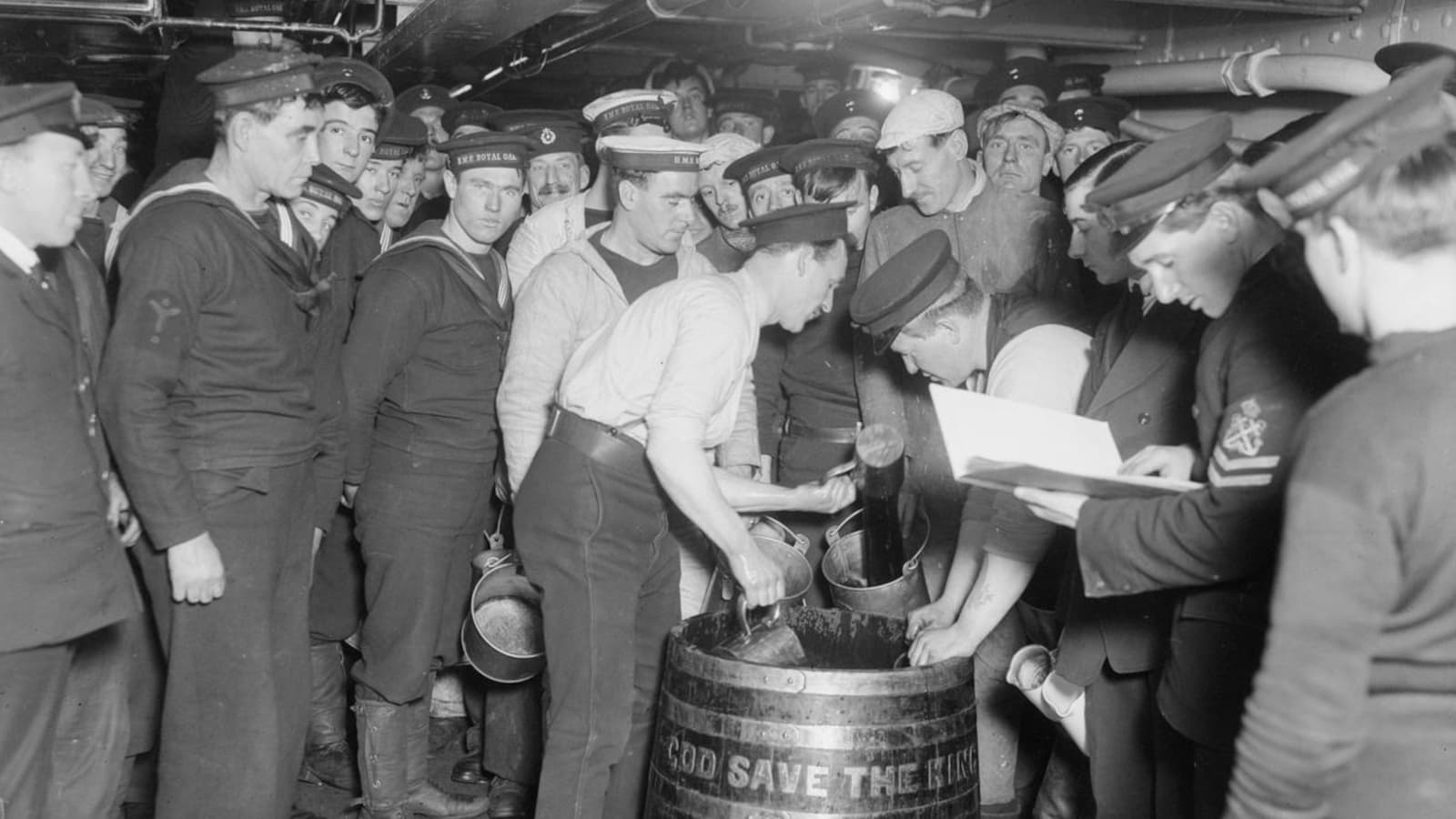
The term ‘Navy Rum’ or ‘Naval Rum’ is a modern one. If one searches through old sources, one finds hardly anything on the subject. Rum was served on Navy ships; in later times, this took the form of a blend, designed to suit the sailors’ tastes and ensure a consistently high standard of quality.


The right blend?
An important account comes from P. Curtis, a former First Petty Officer. He demonstrates just how important the right blend was for Navy Rum. He recalls: “Here is a story of recent times by Mr P. Curtis, formerly a chief petty officer, to show just how important blending and taste have always been: ‘One invasion during the 1939-45 war which has never been sufficiently reported was the invasion of “foreign” rums from such places as Australia and South Africa. These foreign varieties were rejected by the older members of the ship’s company. As a dedicated tot drinker, and in my capacity as “chief pusser”, I did my best to satisfy my shipmates, by mixing pukka and foreign, but nothing compared with the original pusser’s to which we were accustomed. After the war, we still held large stocks of the foreign blends, particularly at Singapure where I happened to be, and so Their Lordships, in their infinite wisdom, decided that the superintending victualling store officer should ascertain the exact blend of rum most acceptable to the post-war navy. In HMS Terror, the shore base in Singapore, there were no less than six chief pussers serving at the same time. The SVSO had a brainwave – who better than those six to give an impartial but balanced judgement? Consequently the six of us mustered in his office, furnished with a large table, chairs, samples of rum from everywhere, with cheese, butter, dry biscuits, etc, for cleaning the palate after each sip. The normal method of judging wine is fourfold – the colour, the aroma or nose, the taste, and the aftertaste. Rum is different! As all old timers will know, the only way to drink a tot is to swallow it whole, grimace, and then sit down to appreciate the glow which spreads from the stomach and engenders that wonderful feeling of peace and general bonhomie. The tasting committee proceded with its task – probably the most enjoyable two hours that anyone could device! After a short period for recovery, we dutifully sat down that evening and with a due sense of dedication collated our views. The outcome, as I remember it, was fifty-five percent Demerara, thirty percent Trinidad, with the remainder being rum from Natal and Mauritius. My memory of that blend remains undimmed.” [2-85] [2-86]
Recipe
It must be noted that Navy Rum was a complex blend which was very difficult to replicate without the formula, which was in the possession of the Admiralty. The last stocks of Navy Rum were sold off after 1970, and it seemed as though British Navy Rum, with its alcohol content of ‘95.5 proof’, had disappeared for good. [2-126]
It is said to have possessed an aroma and a smoothness that were unsurpassed by any other rum. [2-126]
Why is there no mention of Navy Rum in the old recipe books? Quite simply – it was not available for purchase and was reserved exclusively for British seamen.
Mitch Wilson seems to sum it up perfectly: “The recipe for Navy Rum changed over the years, and was dependent entirely on the stocks available to the Admiralty at the time. In the early years, ships would have drunk whatever they could pick up from the various ports they visited. Then from the early 1800s, a dedicated 32-wooden blending vat system was constructed in the West India Docks to make the Navy blend. While the English colonies such as Barbados, Guyana, Jamaica and Trinidad provided much of the rum for the Navy, during shortages rums from the Caribbean and around world would have been incorporated including Martinique, Cuba, Mauritius, and even as far as Australia. The rum was brought to London and mixed together in huge wooden vats to create one of the world’s largest and longest running rum blends, with up to four million gallons being blended at its peak. The Royal Navy, perhaps unintentionally, had become one of the pioneers of rum blending.” [6]
A source reports: “The Navy would buy rum principally from English Ports – Barbados, Jamaica, Guyana, and later Trinidad. However, it would also buy rum from other countries if the supplies needed it. The original Navy rum is a continuous ‘world blend’ of almost all available rums – there is no set recipe.” [5] What is true or important about this is that they bought rum from British colonies. And there was a particular flavour they wanted to achieve in the blend. In that respect, it didn’t matter exactly where the rum came from; the blend just had to taste the same every time.
Statistics from 1855 on spirits imported into Great Britain show which rum was supplied to the Navy: 979,358 proof gallons from the West Indies and Mauritius (88.67 per cent), 29,276 proof gallons from the East Indies (2.65 per cent) and 95,889 proof gallons (8.68 per cent) ‘foreign and British’. This may give us an indication of the composition of the Navy Blend at that time. [1-153]
In 1876, a book was published which provides us with important information about Navy Rum: “Fining, Sweetening and Coloring Foreign Wines and Spirits in Bond. … Spirits.— B.O. 16 March, 60. Neither fining nor coloring may be added to foreign spirits for home consumption. B.O. 26 Nov 62, B.O. 2 July 62. The Board by special permission in each case, have allowed the addition of two gallons of sweet fining to each puncheon of rum, for exportation only. B.O. April, 64. Spirits may have sweet finings added to the extent of one per cent, for exportation only, or for bottling in bond, but application must be made to the Board in each instance for their sanction. B.O. Dec 55. Foreign spirits may not be compounded in bond. B.O. Sept 65. Spirits in a vat may be colored for exportation only, to any extent that the merchant may desire; coloring matter may also be added to spirits in casks, but it must be at the time of shipment. Rum, for exportation, may, by special permission of the Board, be flavored in bond by the addition of pine apple juice. In the West India Docks, London, a press has been erected in bond for the process. The juice is in the first instance extracted from the sliced fruit by pressure, and the pulp, after it has been steeped in rum for two or three weeks, is again pressed, and subsequently destroyed in the presence of the proper officers. This flavouring considerably disguises the strength, as indicated by the hydrometer, and consequently there is always a considerable apparent loss in the proof quantity.” [4-191] [4-192] [4-193]
In 1874, lemon zest was also permitted for flavouring: “Flavouring Rum. — 74. Permission has been granted to flavour rum for exportation by the addition of 8 oz. of lemon peel to 100 gallons of rum. — See also Fining, Sweetening and Coloring, p. 192.” [4-569]
What we can gather from this source is that rum could only be sweetened, clarified or coloured for export, and even then only with special permission. Conversely, this means that, as Navy rum was not intended for export, it could not be clarified, sweetened or coloured. [3]
Epilogue
The term ‘Navy Rum’ or ‘Naval Rum’ is a modern one. If one searches through old sources, one finds hardly anything on the subject. Rum was served on Navy ships; in later times, this took the form of a blend, designed to suit the sailors’ tastes and ensure a consistently high standard of quality.
Sources
explicit capitulum
*