In this post, we look at the history of British Navy rum from its beginnings up to the year 1823.
Before 1655
From 1600 until the end of the English Civil War in 1649, the Royal Navy was in decline. After the Civil War, however, it received remarkable support. More than half of the British government’s revenue was spent on the Royal Navy. Such a high percentage was never achieved again. Even towards the end of Queen Victoria’s reign, who died in 1901, when the navy was once again given special support after a long period of neglect, less than a quarter of the government budget was spent on the navy. [2-16][20][21]
However, by 1660, with the accession of Charles II, there was no longer as much money available to spend on the navy. [2-17]
1655-1763
The Origins of Rum
It is often claimed that the history of rum began with the British Navy in 1655. The argument goes like this: at that time, Jamaica was conquered from the Spanish, and rum was then served for the first time on board Royal Navy ships. The reason was simple: although beer and water were standard provisions, and water was replenished at the destination or en route, neither could be preserved. Beer turned sour within a few weeks and water quickly became putrid and slimy, as algae began to grow in it. Water was normally only drunk once the beer had run out. [2-14] Upon arrival in Jamaica, a substitute had to be found, and it was eventually found in rum. [2-14][2-15] I would like to express my reservations regarding this date: in 1655, there were apparently no rum distilleries in Jamaica, though there certainly were in Barbados. I also wonder why rum was only brought on board in Jamaica and not already in Barbados? One must not take everything that is written at face value.
Under Spanish rule, tobacco was the main crop grown in Jamaica, with sugar cane cultivated only on a small scale. There are no records from the Spanish period of rum production or consumption in Jamaica. Both only emerged under British rule. It is worth noting that in 1654, a year before the British conquest, Jamaica had a population of just 2,500. [5]
It is also the case that the distribution of rum on British warships following the conquest of Jamaica in 1655 remained unclear well into the 18th century. Furthermore, prior to 1731, there were no regulations or instructions on this matter within the Royal Navy; commanders-in-chief made their own decisions and laid down the rules governing the distribution of rum. [2-15]
Although captains were permitted to substitute beer with fortified wine or – it is believed – even with brandy, none of these were available in the West Indies. Rum, on the other hand, could be obtained. Although its use had not yet been officially authorised by the Victualling Board, it was an obvious alternative. [2-15]
Nevertheless, it must be assumed that rum was used on the ships, not brandy. It was simply too cheap for that. That is why Sir Dalby Thomas, the Governor of Jamaica, wrote in 1690: “We must consider the spirits arising from Melasses … which, if it were all turned into spirits, would amount annually to above £500,000 at half the price the like quantity of brandy would cost.”[8-14][8-15]
We do not know what the quality of the rum was like back then. Compared to the later, carefully crafted blends, however, it was certainly of a lower standard. Furthermore, until the invention of Bartolomew Sikes’s hydrometer in 1816, its alcohol content could not be measured accurately; at that time, it was either proof or not proof. [2-16]
The distinction between proof and not proof dates back to the 16th century. At that time, England began to tax spirits differently depending on their alcohol content. If the spirit burned, it was proof. Another method involved soaking gunpowder in a spirit. If the gunpowder could then still be ignited, the spirit was proof. Proof traditionally corresponds to an alcohol content of 57.15% by volume. [3]
A Nation of Rum Drinkers
Thanks to its colonies, Britain became a prosperous nation in the 18th century. It also became a rum-drinking nation; the statistics bear this out. In 1697, a mere 100 litres (22 gallons) of rum were landed in Britain. [8-15] By 1750, 4.5 million litres of rum were being imported, and this figure was to triple over the next two decades. [5] In 1780, rum accounted for 25% of total spirits consumption. [5][8-15]
The first major rum port was Bristol, from where trade with Barbados originally took place. During the 18th century, almost 60% of the city’s trade originated from the Caribbean. From 1780 onwards, trade declined because ships could no longer reach the port, as the narrow Avon Gorge was not to be dredged. Trade shifted to London. [8-15]
Glasgow, too, began trading with Barbados soon after colonisation. The ‘Wester Sugar House’ began operations there in 1667, soon followed by a distillery. Further distilleries were also established. Although rum was imported, it was also distilled locally! At the beginning of the 18th century, it was in fact the distillation rather than the refining of sugar that was the main activity of the ‘Sugar Houses’, not only in Glasgow, but also in Bristol, London and Liverpool. [5][8-15]
Jamaica as a naval base
But let us turn our attention back to Jamaica. Following the conquest of Jamaica, the British Navy maintained only two island bases in the Caribbean capable of providing adequate logistical support for warships; these were located in Barbados and Jamaica. [2-19]
However, Jamaica was slow to realise its full potential as a naval base following its conquest in 1655. In 1727, for example, the HMS Greyhound was anchored in Port Royal, and the crew had to assist in the construction of a shipyard where keels were laid. The workers were lethargic due to the hot climate. [2-18] John Gascoigne, the captain of the Greyhound, [19] therefore wrote on board his ship on 14 February 1727: “If anything can make it agreeable to them, it may be a double allowance of rum being joined to what extra pay may be thought proper to give them.”[2-18][2-19][19]
The crew were already receiving half a pint of rum a day as an alternative to beer. John Gascoigne therefore suggested increasing this amount to a full pint – more than half a litre – to encourage them to work harder! [2-19]
Rum as an official part of the ration
It was finally in 1731 that an official order was issued stipulating that the Navy’s daily rum ration should be half a pint, as an alternative to beer. For the first time, standard rules were established for the Navy, which stated: “Of the Provisions. In case it should be thought for the Service to alter any of the foregoing particulars of provisions in ships employed on foreign voyages, it is to be observed that a pint of wine or half a pint of brandy, rum or arrack, hold provision to a gallon of beer.”[2-19]
The year 1740 and Admiral Vernon mark another milestone for Navy Rum. Admiral Vernon was revered by sailors for his humanity, as he took their concerns to heart. It is even said that he was something of a ‘miniature Nelson’. When it came to reforms, he was ahead of his time, and time and again he urged the Admiralty to show greater humanity. This leniency, however, came at a price: he expected high standards from his sailors – and he got them. [2-21]
However, there was a problem in Jamaica: rum was cheap and easily available. With a little ingenuity, it was possible to smuggle it aboard unnoticed. For example, people would drill holes in coconuts, pour out the coconut milk, fill the nut with rum, and seal it back up. [2-22]
Drinking too much rum was a common problem, and Admiral Vernon’s solution was to serve it diluted with water. That was the birth of Grog. [2-22]
In 1756, the regulations dating from 1731 were expanded. Following the publication of Grog in 1740 under Admiral Vernon, the Admiralty issued an official directive in 1756 requiring that rum be diluted with water when served. [2-29] At the same time, regulations were enacted regarding the safe storage of rum in separate compartments on board, as rum was a flammable liquid, requiring special care on a wooden ship to prevent fire and explosion. [2-30]
The importance of rum is also evident from a letter addressed to the British Parliament in 1757, which states: “it is death to drink beer or water in the field. Without a mixture of rum in the winter, it is impossible to endure the cold.”[7-35]
1763-1793
The Admiralty had no trouble ensuring a steady supply of rum. It was readily available and cheap. As a result, the sailors quickly came to regard their daily rum ration as their right and demanded it whenever it was available. Denying it meant causing trouble. [2-41]
Sir Gilbert Blane of Blanefield, geboren im Jahr 1749 und verstorben 1834, war ein schottischer Arzt, der eine Gesundheitsreform in der Royal Navy einführte. [18] Er empfahl die Verwendung von Spruce Beer, Porter, Ale und Wein anstelle der stärkeren alkoholischen Destillate. [2-41] Er schrieb: »Der Missbrauch von Spirituosen ist überall äußerst schädlich, sowohl als Unterbrechung der Pflicht als auch als Schaden für die Gesundheit. Das gilt besonders für die Westindischen Inseln, weil der Rum von schlechter und ungesunder Qualität ist und weil diese Art der Ausschweifung in einem heißen Klima schädlicher ist als in einem kalten und eine der häufigsten Ursachen für die Erregung der bösartigen Fieber ist, die den tropischen Ländern eigen sind. Zu Recht wird dem neuen Rum vorgeworfen, er sei ungesünder als der alte; denn wenn er lange gelagert wird, wird er nicht nur schwächer und milder durch das Ausatmen eines Teils des Alkohols, sondern es wird auch Zeit für die Verdunstung eines gewissen ekelerregenden, empyreumatischen Prinzips gelassen, das bei der Destillation übergeht und für den Magen sehr unangenehm ist. Ein weiterer Einwand gegen den auf den Westindischen Inseln angebotenen Rum ist die Beimischung von Blei, die er von den bei der Destillation verwendeten Kesseln erhält. Ursprünglich war es üblich, den Seeleuten die ihnen zugeteilte Menge an Spirituosen unverdünnt zu servieren. Die heute gebräuchliche Methode, ihm Wasser beizumischen, wurde erstmals von Admiral Vernon im Jahr 1740 eingeführt und erhielt den Namen Grog. Dies war eine große Verbesserung, denn die Menge von einer halben Pinte, die jedem Mann täglich verabreicht wird, berauscht die meisten Menschen in erheblichem Maße, wenn sie auf einmal und in reinem Zustand eingenommen wird.« [1-323][1-324][17-357]
John Brown Hamilton: Transactions of the International medical congress. 1887, page 357. [17-357]
Sir Gilbert Blane of Blanefield, born in 1749 and died in 1834, was a Scottish physician who introduced health reforms in the Royal Navy. [18] He recommended the use of spruce beer, porter, ale, and wine instead of stronger alcoholic spirits. [2–41] He wrote: “The abuse of spirituous liquors is extremely pernicious everywhere, both as an interruption to duty and as it is injurious to health. It is particularly so in the West Indies, both because the rum is of a bad and unwholesome quality and because this species of debauchery is more hurtful in a hot than in a cold climate, and one of the most common causes of exciting the malignant fevers peculiar to tropical countries. It is with reason that the new rum is accused of being more unwholesome than what is old ; for when long kept it not only becomes weaker and more mellow by part of the spirit exhaling, but time is allowed for the evaporation of a certain nauseous, empyreumatic principle which comes over in the distillation, and which is very offensive to the stomach. Another objection to the rum supplied in the West Indies is the admixture of lead, which it acquires from the vessels employed in distilling. It was originally the custom to serve seamen with their allowance of spirits undiluted. The method now in use, of adding water to it, was first introduced by Admiral Vernon, in the year 1740, and got the name of grog. This was a great improvement, for the quantity of half a pint, which is the daily allowance to each man, will intoxicate most people to a considerable degree, if taken at once, in a pure state.”[1-323][1-324][17-357]
A. James Pack aptly notes: “Blane was right of course, for the aging of rum along with its and blending became increasingly important in providing a liquor which was acceptable aboard ship until that time when naval rum acquired vintage quality. The rum broker, the victualling department and the consumer (the seamen themselves), all helped to make it a subject of connoisseurs.”[2-41]
Centralization of the Rum Supply
However, in the early days of rum rations, when they were distributed only on ships in West Indian waters, rum was purchased directly on site from local suppliers. The ship’s purser had to accept whatever was offered, no matter how poor the quality or how high the price of the rum. [2-43]
Later, however, when rum had to be regularly supplied to ships in England as provisions, this delivery was organized by commissaries through contractors. Since they did not handle the rum themselves, a ship’s purser could still be at the mercy of dishonest contractors [2-43]
Originally, the Provisions Office had developed independently of the Navy. The two grew together only slowly. Beginning in 1742, the warehouses were moved downstream from Tower Hill to Deptford, where they came increasingly under the direct control of the Office. Eventually, the commissioners had absolute control over rum deliveries. In 1782, the Treasury issued general regulations for the duty-free receipt and storage of spirits. On this basis, the Provisions Office was able to enter into a contract for the delivery of rum with a single broker. It is believed that this most likely also led to an improvement in the quality of the rum, as no broker wanted to lose such a valuable contract. [2-43]
Deptford Dockyard
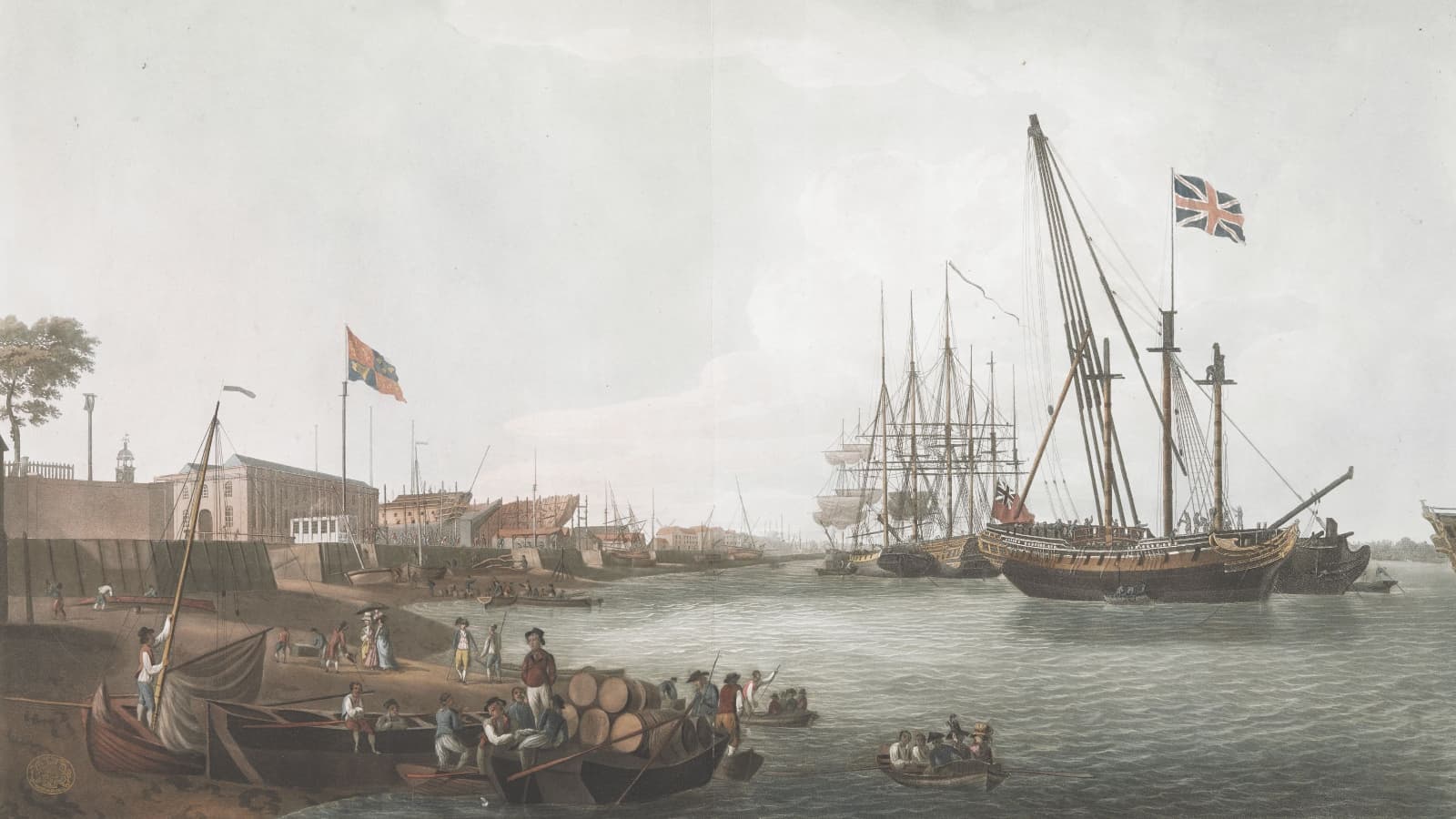
A View of the Royal Dockyard at Deptford, 1789. [22]
At this point, we should briefly turn our attention to the Deptford Dockyard, as this is where the Navy Blend was produced. Deptford had rum warehouses that were built in 1780. [16-22] Wikipedia states: “Deptford Dockyard was an important naval dockyard and base at Deptford on the River Thames, operated by the Royal Navy from the sixteenth to the nineteenth centuries. It built and maintained warships for 350 years, and many significant events and ships have been associated with it. … The yard expanded rapidly throughout the sixteenth and seventeenth centuries, encompassing a large area and serving for a time as the headquarters of naval administration, and the associated Victualling Yard became the Victualling Board’s main depot.”[9]
Furthermore, Wikipedia states: “HM Victualling Yard, Deptford was a Royal Navy Victualling Yard established alongside Deptford Royal Dockyard on the River Thames. There was victualling activity on the site for the best part of 300 years from the mid-17th century through to the early 1960s. … Rebuilt in the late 18th century, it soon became ‘the largest food-processing operation in Britain, if not in Europe’. … In addition, it routinely supplied the other naval victualling yards, both at home and abroad, with items of stock (to supplement those sourced or produced locally) ranging from rum, food and tobacco to clothing and medical supplies. … Brewing ceased in the yard after the beer ration was discontinued in the 1830s; the old brewhouse instead became a clothing store. Rum then became the main alcoholic provision of the Royal Navy and Deptford managed its supply.”[10]
Increasing demand
During the American War of Independence (1775 to 1783), the demand for rum rose year on year. There is no doubt that rum was popular and was preferred to all other alternatives. [2-49] Space on board was limited, and when ships were not in home waters, it was not always possible to replenish rum supplies. In foreign ports, therefore, the substitute products permitted by regulations were purchased. [2-49]
In the Mediterranean, wine and sometimes brandy were available; in the Far East, it was arrack. This had a reputation for being strong, but there is no evidence that it was particularly popular on board. It was only drunk once all other spirits had been used up. Wine, too, was generally of only mediocre quality and was therefore regarded as a poor substitute for rum. The favourites were two Spanish white wines: Rosolio and Mistela. The latter was nicknamed ‘Miss Taylor’ by the sailors. [2-50][2-51]
Exclusive brokerage rights for James Man
In 1784, the exclusive brokerage rights for the supply of rum to the Royal Navy were granted to James Man. He was a cooper and merchant who traded in numerous goods originating from the West Indies. He procured rum with an alcohol content of approximately 40% overproof. This rum was delivered to a customs warehouse, where it was purchased by the Supply Office. The Office then organised, in conjunction with the Customs and Excise Department, the transport of the rum to Deptford, and later to Gosport and Devonport, where the alcohol content was reduced for the provisioning of the ships. [2-70]
James must have done a good job, because his family supplied rum under this contract for almost two hundred years. [2-70]
1793-1824
The West India Docks
We must also look at the West India Docks, as that is where rum from the West Indies was unloaded in London.
A view of the proposed West India Docks and City Canal by W Daniell, 1802. [23]
The English Wikipedia states: “The West India Docks are a series of three docks, quaysides, and warehouses built to import goods from, and export goods and occasionally passengers to the British West Indies. Located on the Isle of Dogs in London, the first dock opened in 1802. … Robert Milligan (c. 1746–1809) of a Scottish family, was largely responsible for the construction of the West India Docks. He was a wealthy West Indies merchant, slave trader and ship owner, who returned to London having managed his family’s Jamaica sugar plantations. Outraged at losses due to theft and delay at the extensive (continuously along the Thames for 11 miles (18 km)) riverside wharves comprising the Port of London, Milligan headed a group of powerful businessmen (including George Hibbert, the chairman of the London Society of West India Planters and Merchants who was a merchant, politician, and ship-owner) who promoted the creation of a wet dock circled by a high wall. The group planned and built West India Docks, lobbying Parliament to allow the creation of a West India Dock Company. Milligan served as both deputy chairman and chairman of the West India Dock Company. The docks were authorised by the Port of London Improvement and City Canal Act 1799. The docks were constructed in two phases. The two northern docks were constructed between 1800 and 1802 for the West India Dock Company … The docks were formally opened on 27 August 1802 … For the following 21 years all vessels in the West India trade using the Port of London were compelled to use the West India docks by a clause in the act of Parliament that had enabled their construction. … The southern dock, the South West India Dock, later known as South Dock, was constructed in the 1860s. … The original docks consisted of an Import Dock of 30 acres (120,000 m2) of water, later named North Dock, and an Export Dock of 24 acres (97,000 m2), later named Middle Dock. Between them, the docks had a combined capability to berth over 600 vessels. … Around the Import Dock a continuous line of five-storey warehouses was constructed … The Export Dock needed fewer buildings as cargo was loaded upon arrival. To protect against theft, the whole complex was surrounded by a brick wall 20 ft (6.1 m) high.”[12]
What else is there to say about the West India Docks? Rum was stored there. As early as 1819, the rum barrels were being handled using cranes and hydraulic machinery. [13] Matt Pietrek writes that the West India Docks were home to the largest rum warehouse the world has ever seen: “The 40,000 rum puncheons within contained more than 18 million liters. That amount of rum diluted to 40 percent ABV would fill more than 48 million of today’s 750 ml bottles.” [14]
Incidentally, it caused a minor scandal when it emerged that, during the Second Coalition War against France, which lasted from 1798 to 1802, the Navy was contractually supplied with brandy by French merchants, even in wartime. [2-51][15] So there was brandy available to the Navy, albeit in small quantities.
Measurements of alcohol content improve
Initially, the alcohol content of rum was determined simply as proof or not proof. After Bartolomew Sikes invented the hydrometer in 1816, it became possible to determine alcohol content more reliably. In 1818, the alcohol content measured using this method was established as the basis for taxation. [2-16][2-70][2-71]
Organisational changes
In the first two decades following the end of the Second Coalition War, an organisational structure was established that was far better suited to the fleet’s requirements. [2-71]
The ritual of issuing rum rations
From Vernon’s time until the end of the Napoleonic Wars, which ended in 1815, [11] grog—that is, rum diluted with water—was usually issued twice a day in the Navy when beer was not available. [2-146] A ritual had developed around this, and in Napoleon’s time the ship’s ‘fiddler’ or ‘fifer’ played an important role in it. The start of his playing announced the distribution of rum. The favourite song in the Navy for this occasion was ‘Nancy Dawson’. Thus, with the morning ration at 12 o’clock after hard work, the pleasant part of the day began. The second ration was served in the evening. [2-146]
Horatio Nelson and his preservation in a brandy cask
The death of Horatio Nelson at the Battle of Trafalgar in 1805 aboard HMS Victory must not go unmentioned. His body was placed in a cask containing brandy mixed with camphor and myrrh. The cask was lashed to the mainmast of the Victory and placed under guard. This decision was not without controversy; the public later felt it would have been better to place him in rum instead, to preserve him more effectively. After the battle, the Victory was towed to Gibraltar, where the body was placed in a lead-lined coffin filled with brandy and shipped to England. [4]
Nevertheless, the legend of ‘Nelson’s Blood’ persists: ‘Nelson’s Blood’ was the name given to rum after the Battle of Trafalgar, because it was mistakenly believed that Lord Nelson’s body had been brought back to England in a barrel of pure rum. [2-196] This legend has been embellished even further, and some claim that on the return journey many sailors tapped into the barrel containing Nelson’s body and drank the rum from it, so that by the end of the voyage it was almost empty. [6-63]
The next post in this series will deal with the history of British Navy rum from 1823 onwards.


Before 1655
From 1600 until the end of the English Civil War in 1649, the Royal Navy was in decline. After the Civil War, however, it received remarkable support. More than half of the British government’s revenue was spent on the Royal Navy. Such a high percentage was never achieved again. Even towards the end of Queen Victoria’s reign, who died in 1901, when the navy was once again given special support after a long period of neglect, less than a quarter of the government budget was spent on the navy. [2-16] [20] [21]
However, by 1660, with the accession of Charles II, there was no longer as much money available to spend on the navy. [2-17]
1655-1763
The Origins of Rum
It is often claimed that the history of rum began with the British Navy in 1655. The argument goes like this: at that time, Jamaica was conquered from the Spanish, and rum was then served for the first time on board Royal Navy ships. The reason was simple: although beer and water were standard provisions, and water was replenished at the destination or en route, neither could be preserved. Beer turned sour within a few weeks and water quickly became putrid and slimy, as algae began to grow in it. Water was normally only drunk once the beer had run out. [2-14] Upon arrival in Jamaica, a substitute had to be found, and it was eventually found in rum. [2-14] [2-15] I would like to express my reservations regarding this date: in 1655, there were apparently no rum distilleries in Jamaica, though there certainly were in Barbados. I also wonder why rum was only brought on board in Jamaica and not already in Barbados? One must not take everything that is written at face value.
Under Spanish rule, tobacco was the main crop grown in Jamaica, with sugar cane cultivated only on a small scale. There are no records from the Spanish period of rum production or consumption in Jamaica. Both only emerged under British rule. It is worth noting that in 1654, a year before the British conquest, Jamaica had a population of just 2,500. [5]
It is also the case that the distribution of rum on British warships following the conquest of Jamaica in 1655 remained unclear well into the 18th century. Furthermore, prior to 1731, there were no regulations or instructions on this matter within the Royal Navy; commanders-in-chief made their own decisions and laid down the rules governing the distribution of rum. [2-15]
Although captains were permitted to substitute beer with fortified wine or – it is believed – even with brandy, none of these were available in the West Indies. Rum, on the other hand, could be obtained. Although its use had not yet been officially authorised by the Victualling Board, it was an obvious alternative. [2-15]
Nevertheless, it must be assumed that rum was used on the ships, not brandy. It was simply too cheap for that. That is why Sir Dalby Thomas, the Governor of Jamaica, wrote in 1690: “We must consider the spirits arising from Melasses … which, if it were all turned into spirits, would amount annually to above £500,000 at half the price the like quantity of brandy would cost.” [8-14] [8-15]
We do not know what the quality of the rum was like back then. Compared to the later, carefully crafted blends, however, it was certainly of a lower standard. Furthermore, until the invention of Bartolomew Sikes’s hydrometer in 1816, its alcohol content could not be measured accurately; at that time, it was either proof or not proof. [2-16]
The distinction between proof and not proof dates back to the 16th century. At that time, England began to tax spirits differently depending on their alcohol content. If the spirit burned, it was proof. Another method involved soaking gunpowder in a spirit. If the gunpowder could then still be ignited, the spirit was proof. Proof traditionally corresponds to an alcohol content of 57.15% by volume. [3]
A Nation of Rum Drinkers
Thanks to its colonies, Britain became a prosperous nation in the 18th century. It also became a rum-drinking nation; the statistics bear this out. In 1697, a mere 100 litres (22 gallons) of rum were landed in Britain. [8-15] By 1750, 4.5 million litres of rum were being imported, and this figure was to triple over the next two decades. [5] In 1780, rum accounted for 25% of total spirits consumption. [5] [8-15]
The first major rum port was Bristol, from where trade with Barbados originally took place. During the 18th century, almost 60% of the city’s trade originated from the Caribbean. From 1780 onwards, trade declined because ships could no longer reach the port, as the narrow Avon Gorge was not to be dredged. Trade shifted to London. [8-15]
Glasgow, too, began trading with Barbados soon after colonisation. The ‘Wester Sugar House’ began operations there in 1667, soon followed by a distillery. Further distilleries were also established. Although rum was imported, it was also distilled locally! At the beginning of the 18th century, it was in fact the distillation rather than the refining of sugar that was the main activity of the ‘Sugar Houses’, not only in Glasgow, but also in Bristol, London and Liverpool. [5] [8-15]
Jamaica as a naval base
But let us turn our attention back to Jamaica. Following the conquest of Jamaica, the British Navy maintained only two island bases in the Caribbean capable of providing adequate logistical support for warships; these were located in Barbados and Jamaica. [2-19]
However, Jamaica was slow to realise its full potential as a naval base following its conquest in 1655. In 1727, for example, the HMS Greyhound was anchored in Port Royal, and the crew had to assist in the construction of a shipyard where keels were laid. The workers were lethargic due to the hot climate. [2-18] John Gascoigne, the captain of the Greyhound, [19] therefore wrote on board his ship on 14 February 1727: “If anything can make it agreeable to them, it may be a double allowance of rum being joined to what extra pay may be thought proper to give them.” [2-18] [2-19] [19]
The crew were already receiving half a pint of rum a day as an alternative to beer. John Gascoigne therefore suggested increasing this amount to a full pint – more than half a litre – to encourage them to work harder! [2-19]
Rum as an official part of the ration
It was finally in 1731 that an official order was issued stipulating that the Navy’s daily rum ration should be half a pint, as an alternative to beer. For the first time, standard rules were established for the Navy, which stated: “Of the Provisions. In case it should be thought for the Service to alter any of the foregoing particulars of provisions in ships employed on foreign voyages, it is to be observed that a pint of wine or half a pint of brandy, rum or arrack, hold provision to a gallon of beer.” [2-19]
The year 1740 and Admiral Vernon mark another milestone for Navy Rum. Admiral Vernon was revered by sailors for his humanity, as he took their concerns to heart. It is even said that he was something of a ‘miniature Nelson’. When it came to reforms, he was ahead of his time, and time and again he urged the Admiralty to show greater humanity. This leniency, however, came at a price: he expected high standards from his sailors – and he got them. [2-21]
However, there was a problem in Jamaica: rum was cheap and easily available. With a little ingenuity, it was possible to smuggle it aboard unnoticed. For example, people would drill holes in coconuts, pour out the coconut milk, fill the nut with rum, and seal it back up. [2-22]
Drinking too much rum was a common problem, and Admiral Vernon’s solution was to serve it diluted with water. That was the birth of Grog. [2-22]
In 1756, the regulations dating from 1731 were expanded. Following the publication of Grog in 1740 under Admiral Vernon, the Admiralty issued an official directive in 1756 requiring that rum be diluted with water when served. [2-29] At the same time, regulations were enacted regarding the safe storage of rum in separate compartments on board, as rum was a flammable liquid, requiring special care on a wooden ship to prevent fire and explosion. [2-30]
The importance of rum is also evident from a letter addressed to the British Parliament in 1757, which states: “it is death to drink beer or water in the field. Without a mixture of rum in the winter, it is impossible to endure the cold.” [7-35]
1763-1793
The Admiralty had no trouble ensuring a steady supply of rum. It was readily available and cheap. As a result, the sailors quickly came to regard their daily rum ration as their right and demanded it whenever it was available. Denying it meant causing trouble. [2-41]
Sir Gilbert Blane of Blanefield, geboren im Jahr 1749 und verstorben 1834, war ein schottischer Arzt, der eine Gesundheitsreform in der Royal Navy einführte. [18] Er empfahl die Verwendung von Spruce Beer, Porter, Ale und Wein anstelle der stärkeren alkoholischen Destillate. [2-41] Er schrieb: »Der Missbrauch von Spirituosen ist überall äußerst schädlich, sowohl als Unterbrechung der Pflicht als auch als Schaden für die Gesundheit. Das gilt besonders für die Westindischen Inseln, weil der Rum von schlechter und ungesunder Qualität ist und weil diese Art der Ausschweifung in einem heißen Klima schädlicher ist als in einem kalten und eine der häufigsten Ursachen für die Erregung der bösartigen Fieber ist, die den tropischen Ländern eigen sind. Zu Recht wird dem neuen Rum vorgeworfen, er sei ungesünder als der alte; denn wenn er lange gelagert wird, wird er nicht nur schwächer und milder durch das Ausatmen eines Teils des Alkohols, sondern es wird auch Zeit für die Verdunstung eines gewissen ekelerregenden, empyreumatischen Prinzips gelassen, das bei der Destillation übergeht und für den Magen sehr unangenehm ist. Ein weiterer Einwand gegen den auf den Westindischen Inseln angebotenen Rum ist die Beimischung von Blei, die er von den bei der Destillation verwendeten Kesseln erhält. Ursprünglich war es üblich, den Seeleuten die ihnen zugeteilte Menge an Spirituosen unverdünnt zu servieren. Die heute gebräuchliche Methode, ihm Wasser beizumischen, wurde erstmals von Admiral Vernon im Jahr 1740 eingeführt und erhielt den Namen Grog. Dies war eine große Verbesserung, denn die Menge von einer halben Pinte, die jedem Mann täglich verabreicht wird, berauscht die meisten Menschen in erheblichem Maße, wenn sie auf einmal und in reinem Zustand eingenommen wird.« [1-323] [1-324] [17-357]
Sir Gilbert Blane of Blanefield, born in 1749 and died in 1834, was a Scottish physician who introduced health reforms in the Royal Navy. [18] He recommended the use of spruce beer, porter, ale, and wine instead of stronger alcoholic spirits. [2–41] He wrote: “The abuse of spirituous liquors is extremely pernicious everywhere, both as an interruption to duty and as it is injurious to health. It is particularly so in the West Indies, both because the rum is of a bad and unwholesome quality and because this species of debauchery is more hurtful in a hot than in a cold climate, and one of the most common causes of exciting the malignant fevers peculiar to tropical countries. It is with reason that the new rum is accused of being more unwholesome than what is old ; for when long kept it not only becomes weaker and more mellow by part of the spirit exhaling, but time is allowed for the evaporation of a certain nauseous, empyreumatic principle which comes over in the distillation, and which is very offensive to the stomach. Another objection to the rum supplied in the West Indies is the admixture of lead, which it acquires from the vessels employed in distilling. It was originally the custom to serve seamen with their allowance of spirits undiluted. The method now in use, of adding water to it, was first introduced by Admiral Vernon, in the year 1740, and got the name of grog. This was a great improvement, for the quantity of half a pint, which is the daily allowance to each man, will intoxicate most people to a considerable degree, if taken at once, in a pure state.” [1-323] [1-324] [17-357]
A. James Pack aptly notes: “Blane was right of course, for the aging of rum along with its and blending became increasingly important in providing a liquor which was acceptable aboard ship until that time when naval rum acquired vintage quality. The rum broker, the victualling department and the consumer (the seamen themselves), all helped to make it a subject of connoisseurs.” [2-41]
Centralization of the Rum Supply
However, in the early days of rum rations, when they were distributed only on ships in West Indian waters, rum was purchased directly on site from local suppliers. The ship’s purser had to accept whatever was offered, no matter how poor the quality or how high the price of the rum. [2-43]
Later, however, when rum had to be regularly supplied to ships in England as provisions, this delivery was organized by commissaries through contractors. Since they did not handle the rum themselves, a ship’s purser could still be at the mercy of dishonest contractors [2-43]
Originally, the Provisions Office had developed independently of the Navy. The two grew together only slowly. Beginning in 1742, the warehouses were moved downstream from Tower Hill to Deptford, where they came increasingly under the direct control of the Office. Eventually, the commissioners had absolute control over rum deliveries. In 1782, the Treasury issued general regulations for the duty-free receipt and storage of spirits. On this basis, the Provisions Office was able to enter into a contract for the delivery of rum with a single broker. It is believed that this most likely also led to an improvement in the quality of the rum, as no broker wanted to lose such a valuable contract. [2-43]
Deptford Dockyard
At this point, we should briefly turn our attention to the Deptford Dockyard, as this is where the Navy Blend was produced. Deptford had rum warehouses that were built in 1780. [16-22] Wikipedia states: “Deptford Dockyard was an important naval dockyard and base at Deptford on the River Thames, operated by the Royal Navy from the sixteenth to the nineteenth centuries. It built and maintained warships for 350 years, and many significant events and ships have been associated with it. … The yard expanded rapidly throughout the sixteenth and seventeenth centuries, encompassing a large area and serving for a time as the headquarters of naval administration, and the associated Victualling Yard became the Victualling Board’s main depot.” [9]
Furthermore, Wikipedia states: “HM Victualling Yard, Deptford was a Royal Navy Victualling Yard established alongside Deptford Royal Dockyard on the River Thames. There was victualling activity on the site for the best part of 300 years from the mid-17th century through to the early 1960s. … Rebuilt in the late 18th century, it soon became ‘the largest food-processing operation in Britain, if not in Europe’. … In addition, it routinely supplied the other naval victualling yards, both at home and abroad, with items of stock (to supplement those sourced or produced locally) ranging from rum, food and tobacco to clothing and medical supplies. … Brewing ceased in the yard after the beer ration was discontinued in the 1830s; the old brewhouse instead became a clothing store. Rum then became the main alcoholic provision of the Royal Navy and Deptford managed its supply.” [10]
Increasing demand
During the American War of Independence (1775 to 1783), the demand for rum rose year on year. There is no doubt that rum was popular and was preferred to all other alternatives. [2-49] Space on board was limited, and when ships were not in home waters, it was not always possible to replenish rum supplies. In foreign ports, therefore, the substitute products permitted by regulations were purchased. [2-49]
In the Mediterranean, wine and sometimes brandy were available; in the Far East, it was arrack. This had a reputation for being strong, but there is no evidence that it was particularly popular on board. It was only drunk once all other spirits had been used up. Wine, too, was generally of only mediocre quality and was therefore regarded as a poor substitute for rum. The favourites were two Spanish white wines: Rosolio and Mistela. The latter was nicknamed ‘Miss Taylor’ by the sailors. [2-50] [2-51]
Exclusive brokerage rights for James Man
In 1784, the exclusive brokerage rights for the supply of rum to the Royal Navy were granted to James Man. He was a cooper and merchant who traded in numerous goods originating from the West Indies. He procured rum with an alcohol content of approximately 40% overproof. This rum was delivered to a customs warehouse, where it was purchased by the Supply Office. The Office then organised, in conjunction with the Customs and Excise Department, the transport of the rum to Deptford, and later to Gosport and Devonport, where the alcohol content was reduced for the provisioning of the ships. [2-70]
James must have done a good job, because his family supplied rum under this contract for almost two hundred years. [2-70]
1793-1824
The West India Docks
We must also look at the West India Docks, as that is where rum from the West Indies was unloaded in London.
The English Wikipedia states: “The West India Docks are a series of three docks, quaysides, and warehouses built to import goods from, and export goods and occasionally passengers to the British West Indies. Located on the Isle of Dogs in London, the first dock opened in 1802. … Robert Milligan (c. 1746–1809) of a Scottish family, was largely responsible for the construction of the West India Docks. He was a wealthy West Indies merchant, slave trader and ship owner, who returned to London having managed his family’s Jamaica sugar plantations. Outraged at losses due to theft and delay at the extensive (continuously along the Thames for 11 miles (18 km)) riverside wharves comprising the Port of London, Milligan headed a group of powerful businessmen (including George Hibbert, the chairman of the London Society of West India Planters and Merchants who was a merchant, politician, and ship-owner) who promoted the creation of a wet dock circled by a high wall. The group planned and built West India Docks, lobbying Parliament to allow the creation of a West India Dock Company. Milligan served as both deputy chairman and chairman of the West India Dock Company. The docks were authorised by the Port of London Improvement and City Canal Act 1799. The docks were constructed in two phases. The two northern docks were constructed between 1800 and 1802 for the West India Dock Company … The docks were formally opened on 27 August 1802 … For the following 21 years all vessels in the West India trade using the Port of London were compelled to use the West India docks by a clause in the act of Parliament that had enabled their construction. … The southern dock, the South West India Dock, later known as South Dock, was constructed in the 1860s. … The original docks consisted of an Import Dock of 30 acres (120,000 m2) of water, later named North Dock, and an Export Dock of 24 acres (97,000 m2), later named Middle Dock. Between them, the docks had a combined capability to berth over 600 vessels. … Around the Import Dock a continuous line of five-storey warehouses was constructed … The Export Dock needed fewer buildings as cargo was loaded upon arrival. To protect against theft, the whole complex was surrounded by a brick wall 20 ft (6.1 m) high.” [12]
What else is there to say about the West India Docks? Rum was stored there. As early as 1819, the rum barrels were being handled using cranes and hydraulic machinery. [13] Matt Pietrek writes that the West India Docks were home to the largest rum warehouse the world has ever seen: “The 40,000 rum puncheons within contained more than 18 million liters. That amount of rum diluted to 40 percent ABV would fill more than 48 million of today’s 750 ml bottles.” [14]
Incidentally, it caused a minor scandal when it emerged that, during the Second Coalition War against France, which lasted from 1798 to 1802, the Navy was contractually supplied with brandy by French merchants, even in wartime. [2-51] [15] So there was brandy available to the Navy, albeit in small quantities.
Measurements of alcohol content improve
Initially, the alcohol content of rum was determined simply as proof or not proof. After Bartolomew Sikes invented the hydrometer in 1816, it became possible to determine alcohol content more reliably. In 1818, the alcohol content measured using this method was established as the basis for taxation. [2-16] [2-70] [2-71]
Organisational changes
In the first two decades following the end of the Second Coalition War, an organisational structure was established that was far better suited to the fleet’s requirements. [2-71]
The ritual of issuing rum rations
From Vernon’s time until the end of the Napoleonic Wars, which ended in 1815, [11] grog—that is, rum diluted with water—was usually issued twice a day in the Navy when beer was not available. [2-146] A ritual had developed around this, and in Napoleon’s time the ship’s ‘fiddler’ or ‘fifer’ played an important role in it. The start of his playing announced the distribution of rum. The favourite song in the Navy for this occasion was ‘Nancy Dawson’. Thus, with the morning ration at 12 o’clock after hard work, the pleasant part of the day began. The second ration was served in the evening. [2-146]
Horatio Nelson and his preservation in a brandy cask
The death of Horatio Nelson at the Battle of Trafalgar in 1805 aboard HMS Victory must not go unmentioned. His body was placed in a cask containing brandy mixed with camphor and myrrh. The cask was lashed to the mainmast of the Victory and placed under guard. This decision was not without controversy; the public later felt it would have been better to place him in rum instead, to preserve him more effectively. After the battle, the Victory was towed to Gibraltar, where the body was placed in a lead-lined coffin filled with brandy and shipped to England. [4]
Nevertheless, the legend of ‘Nelson’s Blood’ persists: ‘Nelson’s Blood’ was the name given to rum after the Battle of Trafalgar, because it was mistakenly believed that Lord Nelson’s body had been brought back to England in a barrel of pure rum. [2-196] This legend has been embellished even further, and some claim that on the return journey many sailors tapped into the barrel containing Nelson’s body and drank the rum from it, so that by the end of the voyage it was almost empty. [6-63]
The next post in this series will deal with the history of British Navy rum from 1823 onwards.
Sources
explicit capitulum
*