In this series, I explore the question of what a ‘British Navy Rum’ actually is. When and why did it come into being? Which rums were used to blend it? What regulations were in place? What did it taste like? Has it changed over time?
Prologue
“Upon all the new settlements the Spaniards make, the first thing they do is build a church, the first thing ye Dutch do upon a new colony is to build them a fort, but the first thing ye English do, be it in the most remote part of ye world, or amongst the most barbarous Indians, is to set up a tavern or drinking house.”
This is how Thomas Walduck described his impressions in a letter to John Searle in 1710. [1-196][3] The former was a British sailor who was stationed in the West Indies for about fifteen years at the beginning of the 18th century and travelled through the British and Spanish colonies. [2]
This British affinity for alcohol is also evident from the fact that by 1647, just twenty years after the English had colonised Barbados, there were already 120 taverns in its capital, Bridgetown. [1-196]
Import statistics
To understand what a navy rum is, we need to understand what types of rum were available in London, as it was from these that the navy blend was produced. That is why we will first look at the import statistics.
1773 and 1782
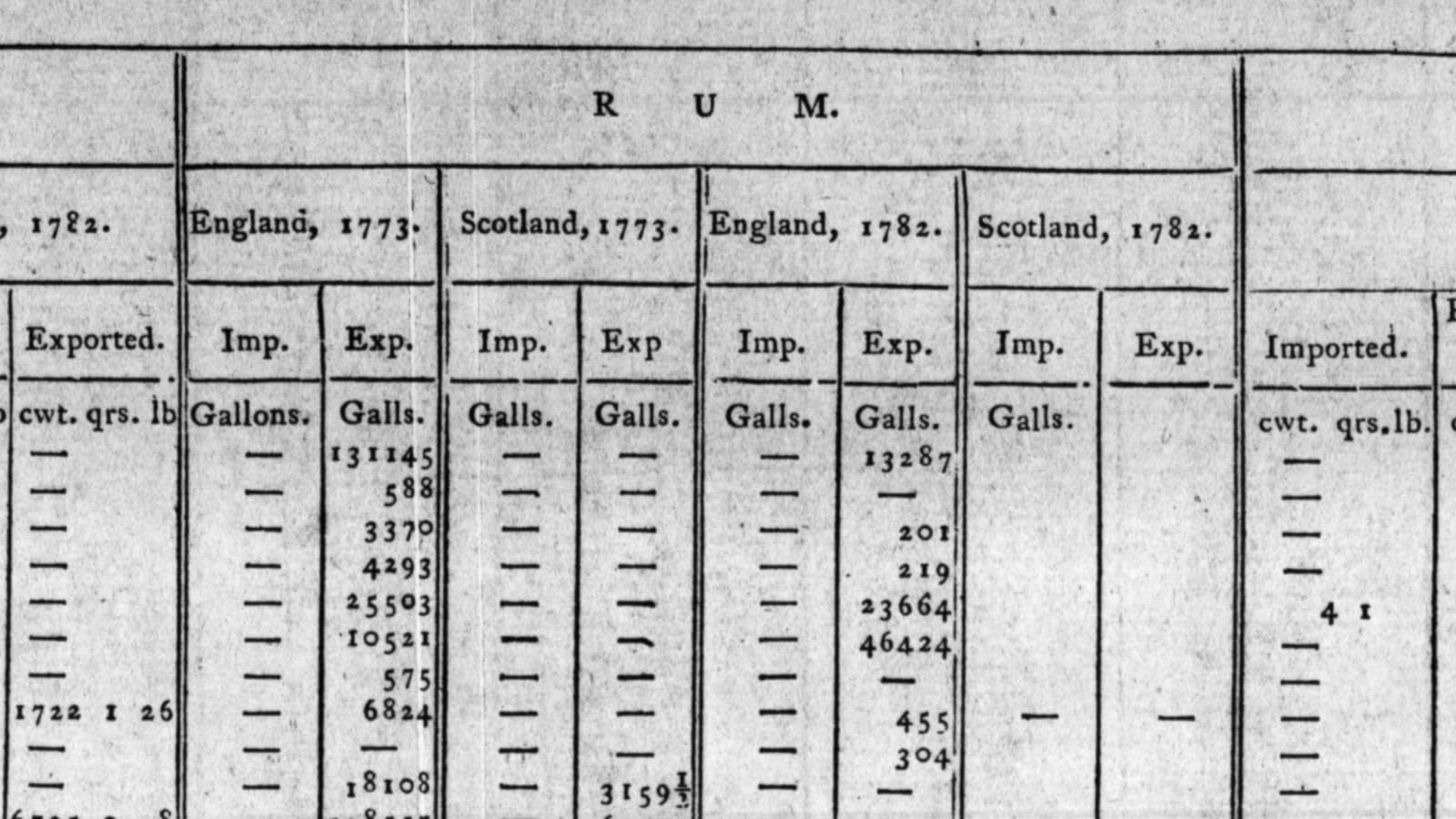
John Lord Sheffield: Observations on the commerce of the American states. 1784, page 345 ff. [6-345 ff.]
The import statistics for England and Scotland for the years 1773 and 1782 reveal some interesting figures. For example, in 1773, 2,282,286.5 gallons of rum were imported into England and Scotland, of which only 14,079 gallons – that is, 0.6% – did not originate from the West Indies. [6-345 ff.]
The five largest suppliers from the West Indies were Jamaica 92.97% (2,121,890.5 gal), Grenada 3.26% (74,509.5 gal), St Vincent 1.15% (26,178 gal), Dominica 0.48% (10,951 gal), Barbados 0.38% (8,629 gal). [6-345 ff.]
It is clear that these quantities were quite variable, as there were slight shifts in 1782, for example. The rest of the world supplied only 117 gallons, and the five largest suppliers in the West Indies were: Jamaica 81.81% (1,422,400 gal), Antigua 8.82% (153,348.5 gal), St Kitts 5.92% (102,910 gal), Nevis 1.05% (18,307 gal), Barbados 0.55% (9,573 gal). [6-345 ff.]
Jamaica is by far the leading source. No rum has yet been imported from Guyana (Demerara). This is hardly surprising, as ownership changed hands several times between the colonial powers of the Netherlands, Great Britain and France until 1814: in 1796, Great Britain took over the three colonies of Essequibo, Demerara and Berbice during hostilities with the French, who had occupied the Netherlands. In 1802, Britain returned control to the Dutch, but conquered the colonies a year later during the Napoleonic Wars. The colonies were officially ceded to the United Kingdom in 1814 and united as the colony of British Guiana in 1831. [10][11]
1808 to 1838
The statistics on rum imports from the West Indies to the United Kingdom reflect this change: the growing importance of British Guiana is evident in the statistics from 1808 to 1838. As the volumes from individual colonies fluctuate considerably in some cases, I have aggregated the data for 10-year periods and then considered only the five largest suppliers. This yields the following average annual picture:
Appendix of official documents … of the colonies of the British Empire. Book I. 1839, page 5. [13-5]
Even though the statistics may be somewhat imprecise – for example, the totals do not add up exactly – they nevertheless paint a clear picture.
1855
British Almanac of the society for the diffusion of useful knowledge, for the year of our Lord 1857. Page 153. [8-153]
Statistics from 1855 on spirits imported into Great Britain illustrate just how important rum was. A total of 7,225,849 proof gallons were imported from the West Indies and Mauritius. Far behind came the East Indies with 617,682 proof gallons and other countries (British or foreign) with 869,806 proof gallons. [8-153]
It is also interesting to note that almost all the rum consumed domestically came from the West Indies or Mauritius: 3,186,623 proof gallons; rum from other sources accounted for only 36,952 proof gallons, of which only 165 were of ‘foreign’ origin. [8-153]
Rum was also exported (a total of 3,209,004 proof gallons), shipped as provisions (246,156 proof gallons), or supplied to the Navy (1,104,523 proof gallons). [8-153]
The Navy’s share was broken down as follows: 979,358 proof gallons from the West Indies and Mauritius, 29,276 proof gallons from the East Indies ‘and mixed’, 93,889 proof gallons of foreign origin, ‘including Foreign and British, vatted together’. [8-153]
Rum was a very important import. By way of comparison: of the 1,943,908 proof gallons of brandy, 1,525,578 were consumed on the domestic market, 910,423 proof gallons were exported, 91,963 proof gallons were sent as stock, and only 2,157 proof gallons went to the Navy! [8-153]
It is often speculated that not only rum, but also brandy and gin were consumed on Royal Navy ships – one need only recall the myths surrounding the Gimlet. These statistics from 1855 now show that the quantity of brandy supplied to the Navy amounted to just 2.3% of the rum supply! Genever was hardly imported at all. Of the 219,041 proof gallons imported, only 25,181 proof gallons went to the domestic market, none to the Navy, and the remainder was re-exported.
176,418 proof gallons for export, 15,428 proof gallons shipped as stock, and none of this for the Navy. Only 96,747 proof gallons of other spirits were imported. Only 96,747 proof gallons of other spirits were imported. [8-153]
I have been unable to find any information on whether, or how much, gin was supplied to the Navy. However, the official regulations suggest that gin was not part of the rations. We are therefore certainly not mistaken in interpreting both of these factors together as a clear indication that there was practically no gin on board.
The 1910s
Joseph Guinness Broodbank: History of the port of London. 1921, page 140. [4-140]
Naturally, rum was mainly imported from British colonies, for as a book on the history of the Port of London, published in 1921, aptly summarises: “The West Indies were in our own hands and better protected because sugar was a food more necessary to the nation, and, moreover, rum was required for the navy.”[4-140]
From an economic point of view, it is better to spend money within one’s own colonies than to purchase rum from other territories. A great deal of rum was imported into Britain from the British colonies, because, unlike the French, Portuguese and Spanish, the British had no domestic wine and spirits trade to protect, and the colonial administration permitted the production of rum and its export to other British colonies. [7-29][7-30]
How much rum was exported from the West Indies in 1913, 1916 and 1917–18?
E. H. S. Flood: The alcohol and the rum trade in the British West Indies. 1920, page 1319-1320. [5-1319]The statistics for 1913 are as follows: British Guyana 3.260.986 gal; Jamaica 953.677 gal; Trinidad 102.323 gal; Leeward Islands 18.464 gal; Barbados 7.963 gal; St. Lucia 1.776 gal; St. Vincent 1.081 gal. [5-1319]
In 1916, the figures were: British Guyana 4.386.834 gal; Jamaica 1.797.913 gal; Trinidad 554.202 gal; Barbados 99.062 gal; St. Lucia 18.014 gal; St. Vincent 8.725 gal. Leeward Islands 2.542 gal; Grenada 1.143 gal; [5-1320]
We can see how significant the proportion of rum from British Guiana had become by this time, and how much the quantities from Jamaica had fallen in contrast.
In the second half of the 18th century, around 85% of imported rum came from Jamaica, with the remaining 15% coming mainly from Barbados, which at that time exported the bulk of its rum to the North American colonies. [9] British rum drinkers at that time preferred Jamaican rum; the Barbadian variety was predominantly re-exported. [9]
These import statistics are also reflected in the Navy’s purchasing patterns: initially, it bought the majority of its rum from Jamaica and Barbados. In the 19th century, rum from Guyana became the preferred choice. [9]
The 1970s
Statistics from the 1970s [12] show the volumes of rum imported into the United Kingdom:
Conny Joy: The United Kingdom market for rum. 1982, page 10. [12-10]
However, no consistent trend is apparent. Total volumes fluctuate between 2,248,000 gal and 8,338,000 gal. Eight times, the largest volume came from Jamaica, and once each from Barbados, Guyana or the Bahamas. At that time, the Navy was no longer purchasing rum. Domestic consumption remained relatively constant, and the large fluctuations in import volumes can be explained by the fact that rum exports from the United Kingdom were on the rise. [12-10]
Conny Joy: The United Kingdom market for rum. 1982, page 11. [12-11]
The large fluctuations in volume may be explained by the fact that there was excess capacity whilst domestic consumption remained relatively constant. [12-10][12-11]
The publication, which dates from 1982, explains: “Indeed present suppliers have excess capacity; their current capacity is estimated at twice the level of demand for their rum.”[12-11]
The accompanying table shows that only 26.7% of the estimated production capacity from the Bahamas, Barbados, Guyana, Jamaica, Trinidad and St Lucia was exported. [12-11]
Now that we have looked at the statistics, the next part of this series will focus on the history of rum in the Royal Navy up to 1823.
Sources
Edward Hamilton: Das Rum-Buch. München, 1998. ISBN 3-7852-8432-2.
Captain Thomas Walduck, Letter to John Searle, 1710, quote taken from Christine Sismondo, America Walks into a Bar: A Spirited History of Taverns and Saloons, Speakeasies and Grog Shops (New York: Oxford University Press, 2011), 4.


Prologue
“Upon all the new settlements the Spaniards make, the first thing they do is build a church, the first thing ye Dutch do upon a new colony is to build them a fort, but the first thing ye English do, be it in the most remote part of ye world, or amongst the most barbarous Indians, is to set up a tavern or drinking house.”
This is how Thomas Walduck described his impressions in a letter to John Searle in 1710. [1-196] [3] The former was a British sailor who was stationed in the West Indies for about fifteen years at the beginning of the 18th century and travelled through the British and Spanish colonies. [2]
This British affinity for alcohol is also evident from the fact that by 1647, just twenty years after the English had colonised Barbados, there were already 120 taverns in its capital, Bridgetown. [1-196]
Import statistics
To understand what a navy rum is, we need to understand what types of rum were available in London, as it was from these that the navy blend was produced. That is why we will first look at the import statistics.
1773 and 1782
The import statistics for England and Scotland for the years 1773 and 1782 reveal some interesting figures. For example, in 1773, 2,282,286.5 gallons of rum were imported into England and Scotland, of which only 14,079 gallons – that is, 0.6% – did not originate from the West Indies. [6-345 ff.]
The five largest suppliers from the West Indies were Jamaica 92.97% (2,121,890.5 gal), Grenada 3.26% (74,509.5 gal), St Vincent 1.15% (26,178 gal), Dominica 0.48% (10,951 gal), Barbados 0.38% (8,629 gal). [6-345 ff.]
It is clear that these quantities were quite variable, as there were slight shifts in 1782, for example. The rest of the world supplied only 117 gallons, and the five largest suppliers in the West Indies were: Jamaica 81.81% (1,422,400 gal), Antigua 8.82% (153,348.5 gal), St Kitts 5.92% (102,910 gal), Nevis 1.05% (18,307 gal), Barbados 0.55% (9,573 gal). [6-345 ff.]
Jamaica is by far the leading source. No rum has yet been imported from Guyana (Demerara). This is hardly surprising, as ownership changed hands several times between the colonial powers of the Netherlands, Great Britain and France until 1814: in 1796, Great Britain took over the three colonies of Essequibo, Demerara and Berbice during hostilities with the French, who had occupied the Netherlands. In 1802, Britain returned control to the Dutch, but conquered the colonies a year later during the Napoleonic Wars. The colonies were officially ceded to the United Kingdom in 1814 and united as the colony of British Guiana in 1831. [10] [11]
1808 to 1838
The statistics on rum imports from the West Indies to the United Kingdom reflect this change: the growing importance of British Guiana is evident in the statistics from 1808 to 1838. As the volumes from individual colonies fluctuate considerably in some cases, I have aggregated the data for 10-year periods and then considered only the five largest suppliers. This yields the following average annual picture:
1808-1817: Jamaica 60,34% (37.455.161 gal), Demerara 9,13 % (5.666.201 gal), Grenada 8,74 % (5.426.727 gal), Tobago 6,73 % (4.178.371 gal), St. Vincents 4,67 % (2.899.427 gal). [13-5]
1818-1827: Jamaica 58,11 % (30776552 gal), Demerara 19,86 % (10517178 gal), Tobago 6,93 % (3669440 gal), Grenada 6,11 % (3233447 gal), St. Vincents 2,81 % (1489572 gal). [13-5]
1828-1838: Jamaica 51,74 % (30152503 gal), Demerara 27,68 % (16129834 gal), Tobago 6,19 % (3604342 gal), Grenada 4,44 % (2589376 gal), Berbice 2,34 % (1360679 gal). [13-5]
Even though the statistics may be somewhat imprecise – for example, the totals do not add up exactly – they nevertheless paint a clear picture.
1855
Statistics from 1855 on spirits imported into Great Britain illustrate just how important rum was. A total of 7,225,849 proof gallons were imported from the West Indies and Mauritius. Far behind came the East Indies with 617,682 proof gallons and other countries (British or foreign) with 869,806 proof gallons. [8-153]
It is also interesting to note that almost all the rum consumed domestically came from the West Indies or Mauritius: 3,186,623 proof gallons; rum from other sources accounted for only 36,952 proof gallons, of which only 165 were of ‘foreign’ origin. [8-153]
Rum was also exported (a total of 3,209,004 proof gallons), shipped as provisions (246,156 proof gallons), or supplied to the Navy (1,104,523 proof gallons). [8-153]
The Navy’s share was broken down as follows: 979,358 proof gallons from the West Indies and Mauritius, 29,276 proof gallons from the East Indies ‘and mixed’, 93,889 proof gallons of foreign origin, ‘including Foreign and British, vatted together’. [8-153]
Rum was a very important import. By way of comparison: of the 1,943,908 proof gallons of brandy, 1,525,578 were consumed on the domestic market, 910,423 proof gallons were exported, 91,963 proof gallons were sent as stock, and only 2,157 proof gallons went to the Navy! [8-153]
It is often speculated that not only rum, but also brandy and gin were consumed on Royal Navy ships – one need only recall the myths surrounding the Gimlet. These statistics from 1855 now show that the quantity of brandy supplied to the Navy amounted to just 2.3% of the rum supply! Genever was hardly imported at all. Of the 219,041 proof gallons imported, only 25,181 proof gallons went to the domestic market, none to the Navy, and the remainder was re-exported.
176,418 proof gallons for export, 15,428 proof gallons shipped as stock, and none of this for the Navy. Only 96,747 proof gallons of other spirits were imported. Only 96,747 proof gallons of other spirits were imported. [8-153]
I have been unable to find any information on whether, or how much, gin was supplied to the Navy. However, the official regulations suggest that gin was not part of the rations. We are therefore certainly not mistaken in interpreting both of these factors together as a clear indication that there was practically no gin on board.
The 1910s
Naturally, rum was mainly imported from British colonies, for as a book on the history of the Port of London, published in 1921, aptly summarises: “The West Indies were in our own hands and better protected because sugar was a food more necessary to the nation, and, moreover, rum was required for the navy.” [4-140]
From an economic point of view, it is better to spend money within one’s own colonies than to purchase rum from other territories. A great deal of rum was imported into Britain from the British colonies, because, unlike the French, Portuguese and Spanish, the British had no domestic wine and spirits trade to protect, and the colonial administration permitted the production of rum and its export to other British colonies. [7-29] [7-30]
How much rum was exported from the West Indies in 1913, 1916 and 1917–18?
In 1916, the figures were: British Guyana 4.386.834 gal; Jamaica 1.797.913 gal; Trinidad 554.202 gal; Barbados 99.062 gal; St. Lucia 18.014 gal; St. Vincent 8.725 gal. Leeward Islands 2.542 gal; Grenada 1.143 gal; [5-1320]
We can see how significant the proportion of rum from British Guiana had become by this time, and how much the quantities from Jamaica had fallen in contrast.
In the second half of the 18th century, around 85% of imported rum came from Jamaica, with the remaining 15% coming mainly from Barbados, which at that time exported the bulk of its rum to the North American colonies. [9] British rum drinkers at that time preferred Jamaican rum; the Barbadian variety was predominantly re-exported. [9]
These import statistics are also reflected in the Navy’s purchasing patterns: initially, it bought the majority of its rum from Jamaica and Barbados. In the 19th century, rum from Guyana became the preferred choice. [9]
The 1970s
Statistics from the 1970s [12] show the volumes of rum imported into the United Kingdom:
However, no consistent trend is apparent. Total volumes fluctuate between 2,248,000 gal and 8,338,000 gal. Eight times, the largest volume came from Jamaica, and once each from Barbados, Guyana or the Bahamas. At that time, the Navy was no longer purchasing rum. Domestic consumption remained relatively constant, and the large fluctuations in import volumes can be explained by the fact that rum exports from the United Kingdom were on the rise. [12-10]
The large fluctuations in volume may be explained by the fact that there was excess capacity whilst domestic consumption remained relatively constant. [12-10] [12-11]
The publication, which dates from 1982, explains: “Indeed present suppliers have excess capacity; their current capacity is estimated at twice the level of demand for their rum.” [12-11]
The accompanying table shows that only 26.7% of the estimated production capacity from the Bahamas, Barbados, Guyana, Jamaica, Trinidad and St Lucia was exported. [12-11]
Now that we have looked at the statistics, the next part of this series will focus on the history of rum in the Royal Navy up to 1823.
Sources
explicit capitulum
*