 Some drinks explain themselves immediately. Others only reveal themselves when you are ready to be still and listen deeply.
Mizuwari is more than just whisky with water – for me, it is an expression of mindfulness: you prepare a Mizuwari in order to prepare a Mizuwari. Not to get it over with. Not to move on to the next step. But to be completely immersed in this one process. In this moment, there is nothing else. Your thoughts do not wander.
When serving, there is nothing more important than serving, and when drinking, nothing more important than drinking. Perhaps that is the essence of Japanese bar culture: a Zen meditation, a modern tea ceremony.
When Steffen Liebehenz told me how long and intensively he had to spend his time during the Corona pandemic mastering the Mizuwari – and how much the Mizuwari was able to give him – it was clear to me: no one would be better suited to introduce us to the Mizuwari. I am delighted to give Steffen the floor at this point.
THE MIZUWARI
By Steffen Liebehenz
The Mizuwari represents Japanese bar culture like no other cocktail – and is definitely the subjective pinnacle of minimalism in the bar, at least from the perspective of the author of these lines.
Like no other drink, it embodies the often-used expression “more than the sum of its parts”. Whisky and water literally merge to create a new, complex but easy-to-enjoy companion for most situations in life. I have seen it turn people who don’t drink whisky into connoisseurs – and inspire whisky connoisseurs to discover whole new sides to their favourite drink.
A drink for everyone – from izakaya to high-end bars
What makes it so unique is that it doesn’t need to be put on a pedestal, but should be viewed from many perspectives. It is a drink that – especially in Japan – is not reserved for an elite class.
On the one hand, it is prepared in a high-end bar in an elaborate ceremony with diamond-cut bar spoons and served on hand-carved ice diamonds; on the other hand, it is also served in small izakayas away from the urban centres or in people’s own homes.
Interestingly, there are even special whiskies in Japan that have been developed specifically for this purpose – I’ll come back to that later.
Minimalism with soul
I like to compare it to the art of painter and sculptor Lee Ufan, whose minimalist works only reveal their effect to the viewer once they engage with them.
In exactly the same way, Mizuwari reveals as much as you invest in it: here, a quick, refreshing drink on a warm day; there, a revelation that elicits unknown aromas from the whisky and completely captivates you. In between, anything is possible.
The bartender’s philosophy
The Mizuwari follows a philosophy that I have often applied to my cocktails in the past:
The character of the spirit is paramount. You should focus on that – and not on your own.
See where the spirit wants to go, and don’t force it down your own path. This creates a harmonious drink that serves the enjoyment of the drinker, not the ego of the bartender.
This concept can also be found in the great classics – such as the Old Fashioned, Daiquiri, Manhattan or Martini – as well as in modern drinks that have achieved world fame, such as the Old Cuban or Basil Smash.
A look back at the past
To truly understand a drink, you have to explore its past. To know where it’s going, you need to know where it came from.
Mizuwari is not as closely linked to whisky as you might think. It was originally made with shōchū, with which it is still widely drunk in Japan today under the same name.
It was not until 1937 that whisky came into play – in the form of Suntory Kakubin, with which Shinjirō Torii not only launched the first commercially successful Japanese whisky, but also set the direction in which this still young category would go in the following decades.
Torii moved away from the strong Scottish style and competed with shōchū and sake. His whisky was not only to be enjoyed on special occasions, but also with meals – either with warm or cold water. This concept worked, and the triumphant advance of Japanese whisky began.
Whisky, water – and everything in between
Today, there are a variety of whiskies that have been specially developed for Mizuwaris and Highballs: modern variants such as Nikka Days or Suntory Toki, classic styles such as Suntory Kakubin or Rare Old Super from Nikka – and even lighter versions such as Nikka Black Clear, which, with its low alcohol content of 37% and a balanced flavour profile, allows you to make a successful Mizuwari even without any technical knowledge.
Just ice, water, whisky – done.
An instant Mizuwari, so to speak.
Mizuwari vs. Highball
A clear distinction must be made here:
The classic Mizuwari is always prepared with still water, while the Highball is made with soda water – and differs significantly in terms of technique and effect.
In a classic Highball, the soda and whisky are first poured into a chilled highball glass, with the ice added last. It is important to ensure that the liquids are as cold as possible and that the ice has already melted on the outside so that the carbon dioxide remains stable.
As with all minimalist cocktails, the following applies:
The fewer ingredients you have, the more important quality and technique become.
The right ingredients
When choosing a spirit, it is important that it has a certain sweetness of its own – otherwise the drink will taste bitter.
Whisky is the classic choice, but shōchū, rum or tequila (preferably reposado or añejo) also work very well. Aged spirits are more suitable than unaged ones – shōchū is a small exception here.
There is less leeway when it comes to water. It should be soft, clear and balanced in terms of mineral content – as little lime, sodium and chloride (around 10 mg/l each) as possible, and low calcium and magnesium content are essential. The wrong water will make the drink unbalanced and spirity.
Rule of thumb: if the water tastes soft and has a velvety mouthfeel, it is ideal.
Preparation – a tea ceremony of ice and silence
The preparation of Mizuwari can almost be seen as a tea ceremony. First, take a suitable glass – in this case, I recommend a tumbler.
Unlike with a Highball, there is no need to worry about the carbon dioxide escaping. The larger surface area also ensures more contact with the air, allowing the flavours to develop better.
Fill the tumbler generously with ice – don’t be too sparing, as it will melt during preparation.
The perfect ice temperature is -5 °C.
Whether large ice blocks or classic cubes – the key thing is that the ice is clear and pure, without air pockets or impurities. White ice just doesn’t taste good.
1. Fill the glass to the brim with ice, then add water and stir briefly.
2. Pour out the water, leaving the ice in the glass (this cleans and tempers it).
3. Add whisky – in a ratio of 1:2 to 1:3 (depending on the time of day and your mood).
4. Stir very slowly and evenly, about 20 times.
Not too fast, not too short – this way, the water and spirit combine to form a homogeneous liquid instead of separating into layers. This is also a good method for most stirred drinks, by the way.
5. Then carefully add the water and stir again 15–20 times.
Finally, squeeze a lemon zest over the glass and add it to the drink. This is how to prepare a classic Mizuwari with whisky and shōchū. You can play around with the garnish for different variations, e.g. grapefruit zest for tequila and lime and possibly some mint for rum.
The variation with hot water is called oyuwari, which comes in two different versions: gogo, with a ratio of 5:5, and rokuyon, with a ratio of 6:4, whereby it is not specified which part is spirit and which is water. With both, it is important to note that the spirit is added to the hot water and not vice versa.
The lesson of Mizuwari
The philosophy behind Mizuwari is crucial:
It only gives you back as much as you put in.
Cocktail-loving readers will not only enjoy an outstanding taste experience here, but also learn a lot about stirring, diluting and balancing:
how the degree of dilution affects spirits, how stirring speed and ice quality change texture and taste – and how alcohol content and temperature shape character.
But: it’s just as acceptable to simply pour everything together until it tastes good.
Mizuwari is never loud – but if you listen to it, it has a lot to say.
A drink that teaches
The Mizuwari is a fine example of how you can not only learn about a drink, but also learn from drinks.
With this in mind, I would like to take my leave.
It is almost impossible to view this drink objectively – the impressions it leaves in all its facets are too subjective.
I hope I have been able to motivate some of you to give it a try.
The important thing is to always be aware of one thing:
The Mizuwari in particular – as well as cocktails in general – is not a science, nor is it a law of nature.
It works from moment to moment – depending on the person drinking and preparing it, the location, the time of day, the weather and the mood.
Therefore, I will refrain from citing sources – the insights described here are based on years of research, drinking, mixing and many conversations with people who either had something relevant or simply interesting to say.
I would particularly like to thank for their inspiration:
• Takeshi Niinami
• Masahiro Urushido
• Mario Kappes
• Stan Vadrna
• Kazuo Ueda
COVER IMAGE
The cover image was created using OpenAI DALL·E. As far as we know, there are no copyright claims by third parties. Use on this blog is in accordance with OpenAI’s terms of use.
explicit capitulum
*



Mizuwari is more than just whisky with water – for me, it is an expression of mindfulness: you prepare a Mizuwari in order to prepare a Mizuwari. Not to get it over with. Not to move on to the next step. But to be completely immersed in this one process. In this moment, there is nothing else. Your thoughts do not wander.
When serving, there is nothing more important than serving, and when drinking, nothing more important than drinking. Perhaps that is the essence of Japanese bar culture: a Zen meditation, a modern tea ceremony.
When Steffen Liebehenz told me how long and intensively he had to spend his time during the Corona pandemic mastering the Mizuwari – and how much the Mizuwari was able to give him – it was clear to me: no one would be better suited to introduce us to the Mizuwari. I am delighted to give Steffen the floor at this point.
THE MIZUWARI
By Steffen Liebehenz
The Mizuwari represents Japanese bar culture like no other cocktail – and is definitely the subjective pinnacle of minimalism in the bar, at least from the perspective of the author of these lines.
Like no other drink, it embodies the often-used expression “more than the sum of its parts”. Whisky and water literally merge to create a new, complex but easy-to-enjoy companion for most situations in life. I have seen it turn people who don’t drink whisky into connoisseurs – and inspire whisky connoisseurs to discover whole new sides to their favourite drink.
A drink for everyone – from izakaya to high-end bars
What makes it so unique is that it doesn’t need to be put on a pedestal, but should be viewed from many perspectives. It is a drink that – especially in Japan – is not reserved for an elite class.
On the one hand, it is prepared in a high-end bar in an elaborate ceremony with diamond-cut bar spoons and served on hand-carved ice diamonds; on the other hand, it is also served in small izakayas away from the urban centres or in people’s own homes.
Interestingly, there are even special whiskies in Japan that have been developed specifically for this purpose – I’ll come back to that later.
Minimalism with soul
I like to compare it to the art of painter and sculptor Lee Ufan, whose minimalist works only reveal their effect to the viewer once they engage with them.
In exactly the same way, Mizuwari reveals as much as you invest in it: here, a quick, refreshing drink on a warm day; there, a revelation that elicits unknown aromas from the whisky and completely captivates you. In between, anything is possible.
The bartender’s philosophy
The Mizuwari follows a philosophy that I have often applied to my cocktails in the past:
The character of the spirit is paramount. You should focus on that – and not on your own.
See where the spirit wants to go, and don’t force it down your own path. This creates a harmonious drink that serves the enjoyment of the drinker, not the ego of the bartender.
This concept can also be found in the great classics – such as the Old Fashioned, Daiquiri, Manhattan or Martini – as well as in modern drinks that have achieved world fame, such as the Old Cuban or Basil Smash.
A look back at the past
To truly understand a drink, you have to explore its past. To know where it’s going, you need to know where it came from.
Mizuwari is not as closely linked to whisky as you might think. It was originally made with shōchū, with which it is still widely drunk in Japan today under the same name.
It was not until 1937 that whisky came into play – in the form of Suntory Kakubin, with which Shinjirō Torii not only launched the first commercially successful Japanese whisky, but also set the direction in which this still young category would go in the following decades.
Torii moved away from the strong Scottish style and competed with shōchū and sake. His whisky was not only to be enjoyed on special occasions, but also with meals – either with warm or cold water. This concept worked, and the triumphant advance of Japanese whisky began.
Whisky, water – and everything in between
Today, there are a variety of whiskies that have been specially developed for Mizuwaris and Highballs: modern variants such as Nikka Days or Suntory Toki, classic styles such as Suntory Kakubin or Rare Old Super from Nikka – and even lighter versions such as Nikka Black Clear, which, with its low alcohol content of 37% and a balanced flavour profile, allows you to make a successful Mizuwari even without any technical knowledge.
Just ice, water, whisky – done.
An instant Mizuwari, so to speak.
Mizuwari vs. Highball
A clear distinction must be made here:
The classic Mizuwari is always prepared with still water, while the Highball is made with soda water – and differs significantly in terms of technique and effect.
In a classic Highball, the soda and whisky are first poured into a chilled highball glass, with the ice added last. It is important to ensure that the liquids are as cold as possible and that the ice has already melted on the outside so that the carbon dioxide remains stable.
As with all minimalist cocktails, the following applies:
The fewer ingredients you have, the more important quality and technique become.
The right ingredients
When choosing a spirit, it is important that it has a certain sweetness of its own – otherwise the drink will taste bitter.
Whisky is the classic choice, but shōchū, rum or tequila (preferably reposado or añejo) also work very well. Aged spirits are more suitable than unaged ones – shōchū is a small exception here.
There is less leeway when it comes to water. It should be soft, clear and balanced in terms of mineral content – as little lime, sodium and chloride (around 10 mg/l each) as possible, and low calcium and magnesium content are essential. The wrong water will make the drink unbalanced and spirity.
Rule of thumb: if the water tastes soft and has a velvety mouthfeel, it is ideal.
Preparation – a tea ceremony of ice and silence
The preparation of Mizuwari can almost be seen as a tea ceremony. First, take a suitable glass – in this case, I recommend a tumbler.
Unlike with a Highball, there is no need to worry about the carbon dioxide escaping. The larger surface area also ensures more contact with the air, allowing the flavours to develop better.
Fill the tumbler generously with ice – don’t be too sparing, as it will melt during preparation.
The perfect ice temperature is -5 °C.
Whether large ice blocks or classic cubes – the key thing is that the ice is clear and pure, without air pockets or impurities. White ice just doesn’t taste good.
1. Fill the glass to the brim with ice, then add water and stir briefly.
2. Pour out the water, leaving the ice in the glass (this cleans and tempers it).
3. Add whisky – in a ratio of 1:2 to 1:3 (depending on the time of day and your mood).
4. Stir very slowly and evenly, about 20 times.
Not too fast, not too short – this way, the water and spirit combine to form a homogeneous liquid instead of separating into layers. This is also a good method for most stirred drinks, by the way.
5. Then carefully add the water and stir again 15–20 times.
Finally, squeeze a lemon zest over the glass and add it to the drink. This is how to prepare a classic Mizuwari with whisky and shōchū. You can play around with the garnish for different variations, e.g. grapefruit zest for tequila and lime and possibly some mint for rum.
The variation with hot water is called oyuwari, which comes in two different versions: gogo, with a ratio of 5:5, and rokuyon, with a ratio of 6:4, whereby it is not specified which part is spirit and which is water. With both, it is important to note that the spirit is added to the hot water and not vice versa.
The lesson of Mizuwari
The philosophy behind Mizuwari is crucial:
It only gives you back as much as you put in.
Cocktail-loving readers will not only enjoy an outstanding taste experience here, but also learn a lot about stirring, diluting and balancing:
how the degree of dilution affects spirits, how stirring speed and ice quality change texture and taste – and how alcohol content and temperature shape character.
But: it’s just as acceptable to simply pour everything together until it tastes good.
Mizuwari is never loud – but if you listen to it, it has a lot to say.
A drink that teaches
The Mizuwari is a fine example of how you can not only learn about a drink, but also learn from drinks.
With this in mind, I would like to take my leave.
It is almost impossible to view this drink objectively – the impressions it leaves in all its facets are too subjective.
I hope I have been able to motivate some of you to give it a try.
The important thing is to always be aware of one thing:
The Mizuwari in particular – as well as cocktails in general – is not a science, nor is it a law of nature.
It works from moment to moment – depending on the person drinking and preparing it, the location, the time of day, the weather and the mood.
Therefore, I will refrain from citing sources – the insights described here are based on years of research, drinking, mixing and many conversations with people who either had something relevant or simply interesting to say.
I would particularly like to thank for their inspiration:
• Takeshi Niinami
• Masahiro Urushido
• Mario Kappes
• Stan Vadrna
• Kazuo Ueda
COVER IMAGE
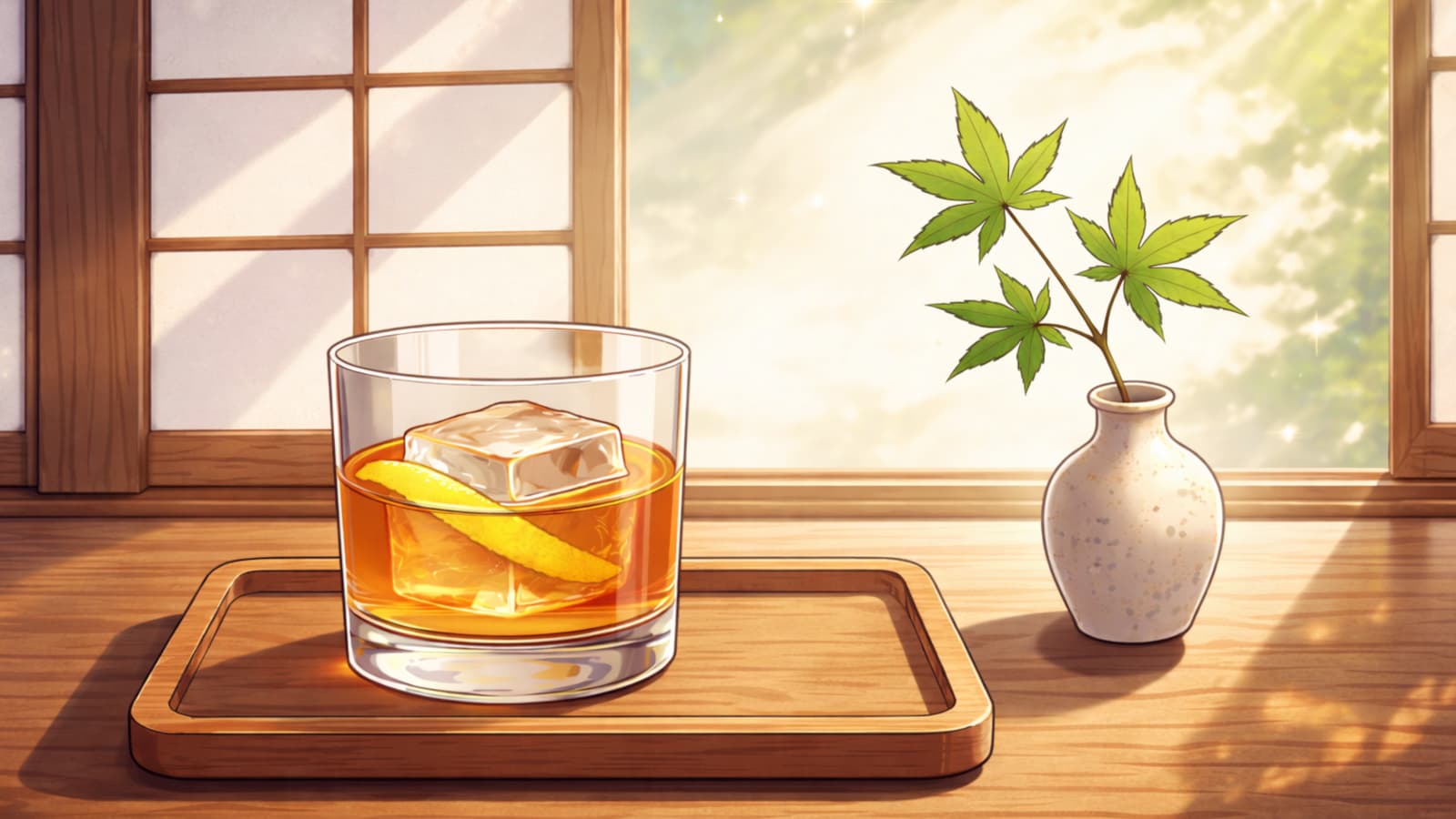
The cover image was created using OpenAI DALL·E. As far as we know, there are no copyright claims by third parties. Use on this blog is in accordance with OpenAI’s terms of use.
explicit capitulum
*